
What is a Solana token? Supply, decimals and authorities explained
This is part of the beginner series. If the notebook and the wallet are new to you, read Solana for beginners first.
What is a token?
A token is a line in Solana's notebook that says who holds how many of something. SOL is Solana's own coin, and everything else, from USDC to memecoins, is a token. Making one is like printing your own arcade tokens: it takes minutes and costs little, but it doesn't make anyone want them.
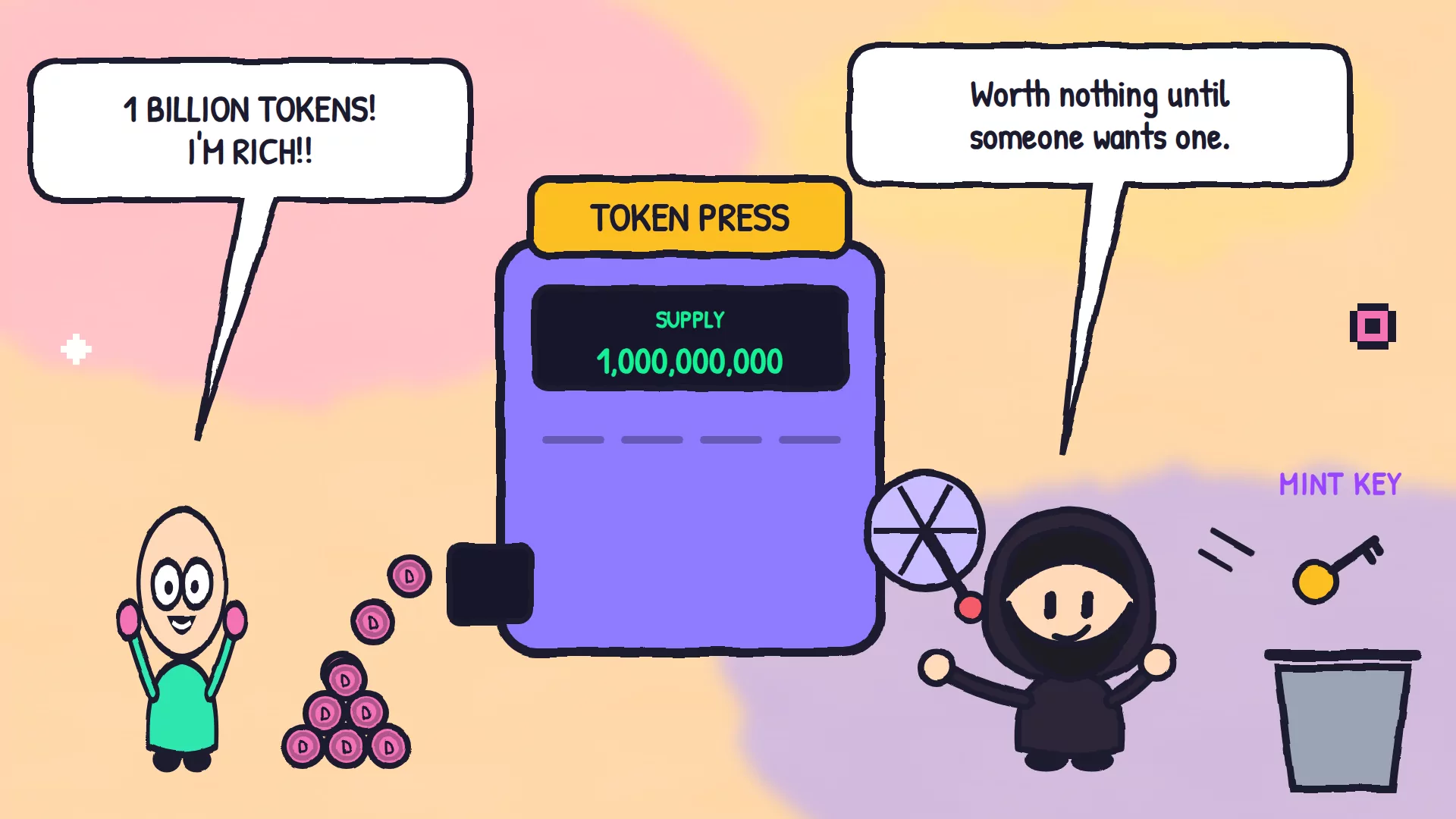
A token is worth whatever someone will pay for it, and nobody can pay for it until there's somewhere to trade it. That's what liquidity pools and bonding curves are for. Until then, a billion tokens are a billion arcade tokens for an arcade that hasn't opened.
What's inside a token?
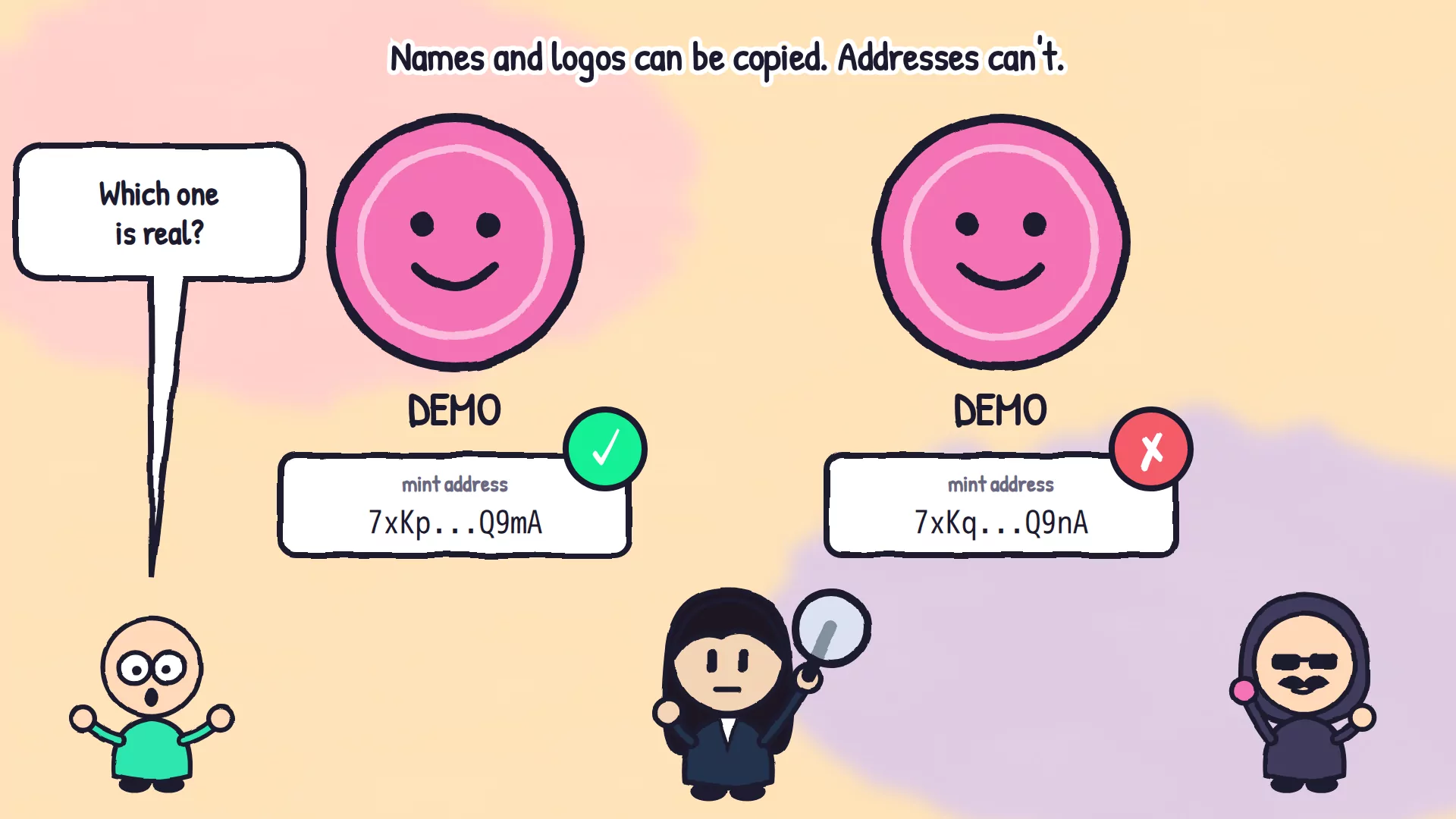
Every token has a mint, which is its master record: its address, its total supply and its number of decimals. Metadata adds the name, symbol and logo that wallets show. The mint address is the token's real identity, because anyone can copy a name and a logo, but nobody can copy an address.
These are three real tokens:
| Token | Mint address | Decimals | Supply | Mint authority | Freeze authority |
|---|---|---|---|---|---|
| Bonk (BONK) | DezXA...B263 | 5 | About 88 trillion | Revoked | Revoked |
| Jupiter (JUP) | JUPyi...DvCN | 6 | About 6.86 billion | Revoked | Revoked |
| USD Coin (USDC) | EPjFW...Dt1v | 6 | Changes as USDC is issued and redeemed | Held by its issuer | Held by its issuer |
- Supply is how many exist. It's just a number: a billion tokens isn't more valuable than a thousand.
- Decimals say how finely a token splits. USDC has 6, so its smallest amount is 0.000001 USDC. SOL itself has 9.
- A copycat can call itself Bonk and use the same dog, but it can't have Bonk's address. Always check the address.
What are mint and freeze authorities?
They're two keys that can come with a token. The mint authority can print more of it, and the freeze authority can lock any holder's tokens so they can't move. A new token usually starts with both, held by its creator. Revoking one throws that key away for good, which is why buyers like to see them revoked.
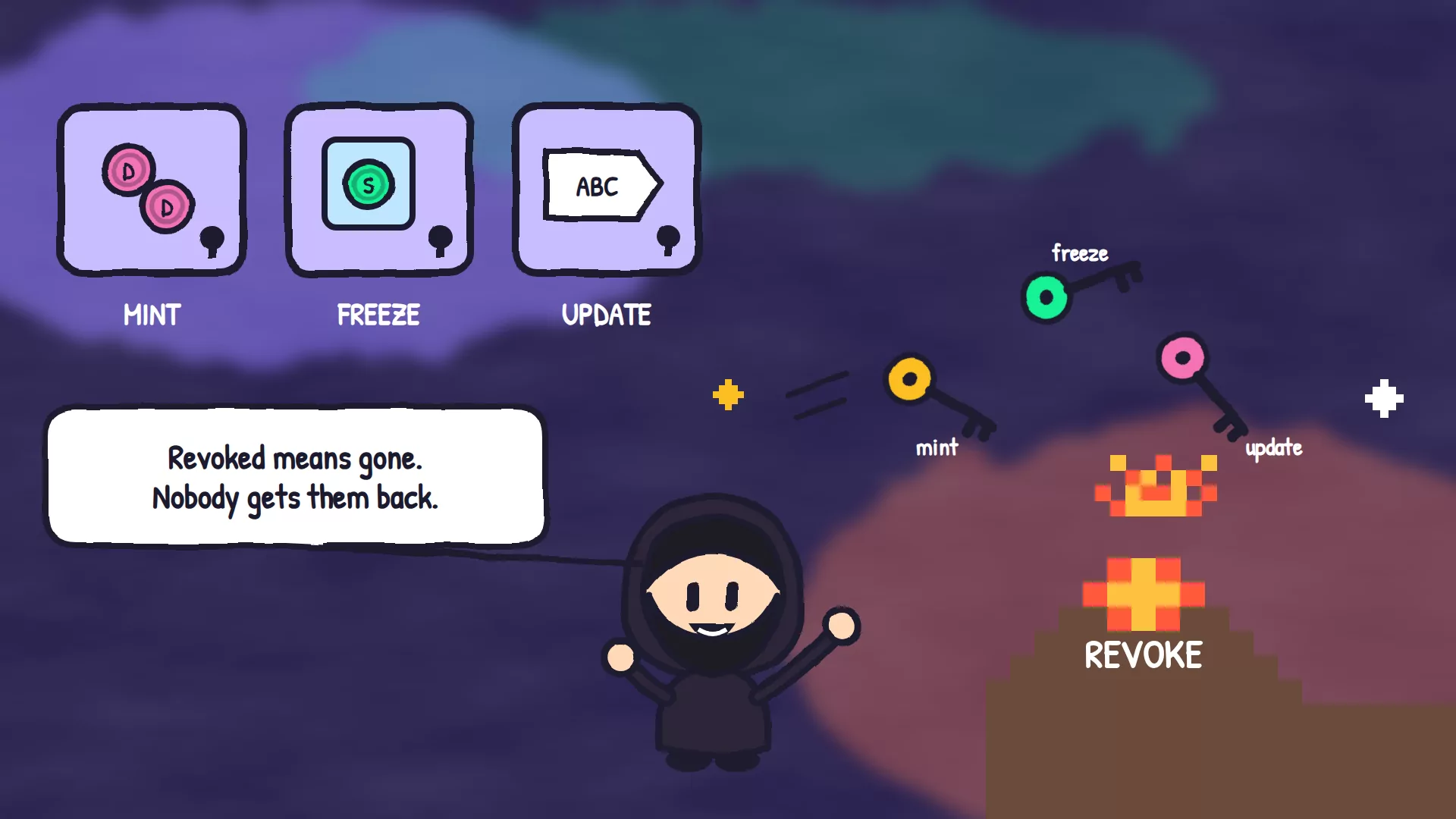
- Mint authority, the printer key. Whoever holds it can create new tokens whenever they like, which makes everyone else's share smaller.
- Freeze authority, the freezer key. Whoever holds it can freeze a wallet's tokens, so they can't be sold or sent.
- Update authority, the label maker. A third key can change the name, symbol and logo. Making metadata immutable throws it away.
A key isn't always bad news. USDC's issuer keeps both, because it creates new USDC when people deposit dollars. For a memecoin, though, an active printer or freezer key is one of the classic rug pull warning signs.
Where do my tokens actually live?
Not in your wallet app. For each kind of token you hold, Solana keeps a small box called a token account, tied to your address. Each box holds a deposit, called rent, of 0.00148844 SOL. When a box is empty, you can close it and get the deposit back, which is what the SOL Incinerator does.
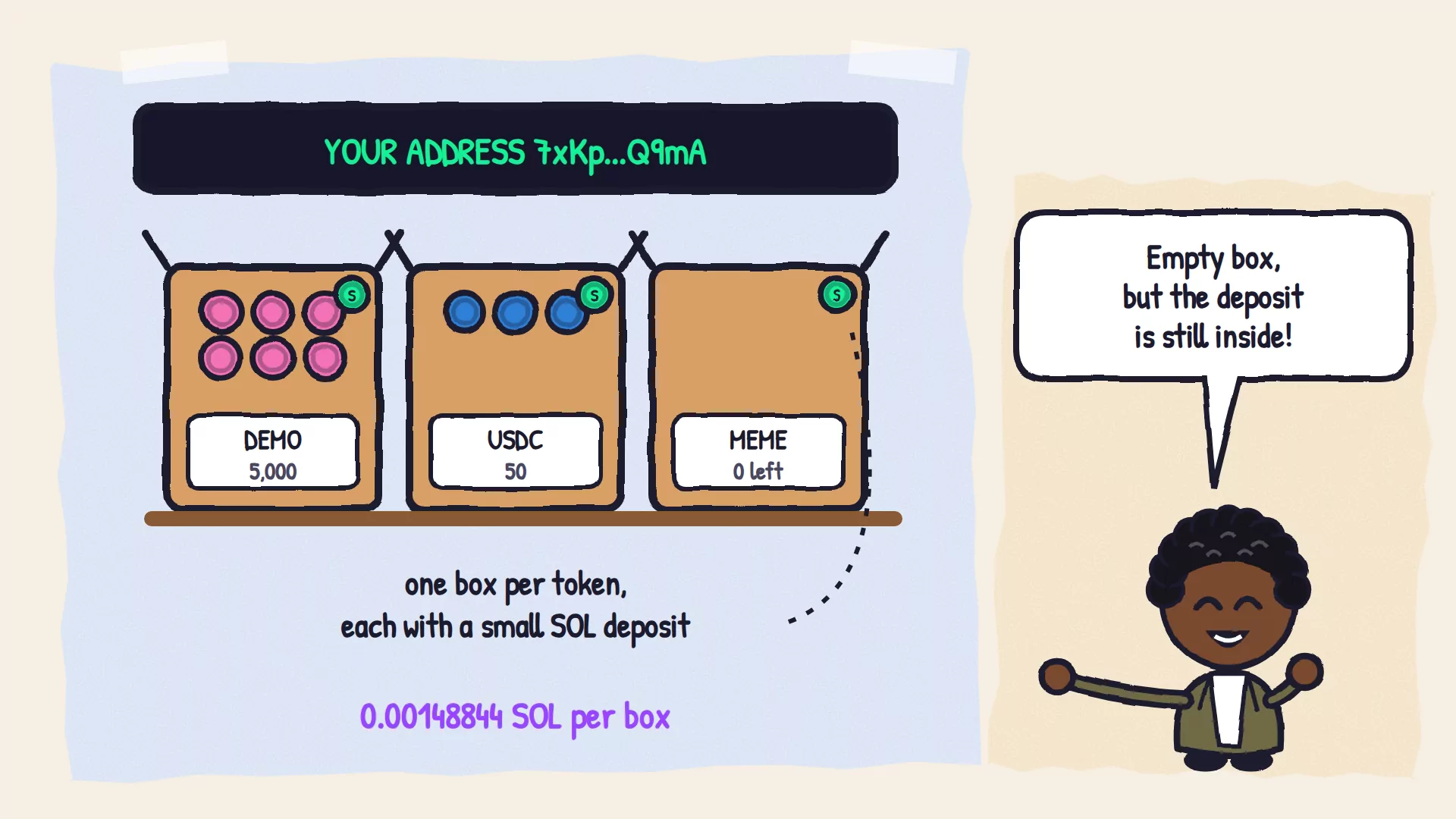
- Who pays for the box: whoever creates it. When you buy a token, that's usually you. When someone sends you one, it's usually them.
- Older boxes hold more. Accounts opened before Solana lowered its rent hold 0.00203928 SOL.
- Selling everything leaves the empty box behind, with its deposit still inside. A busy wallet can have dozens. Money in and out shows how to get it back.
Prerequisites
- A Solana wallet. Solana for beginners shows you how to set one up.
- To make a practice token, some free Devnet SOL from the Solana faucet.
Steps to look up a token, and make your own
- Get the mint address from the source. Copy it from the project's official website or X account, or from your wallet's page for that token. Never go by the name alone.
- Open it on an explorer. Paste it into an explorer such as Solscan or the Solana Explorer. You'll see its supply, decimals and holders.
- Find the two keys. Look for the mint authority and the freeze authority. An address means someone still holds that key. No address means it has been revoked.
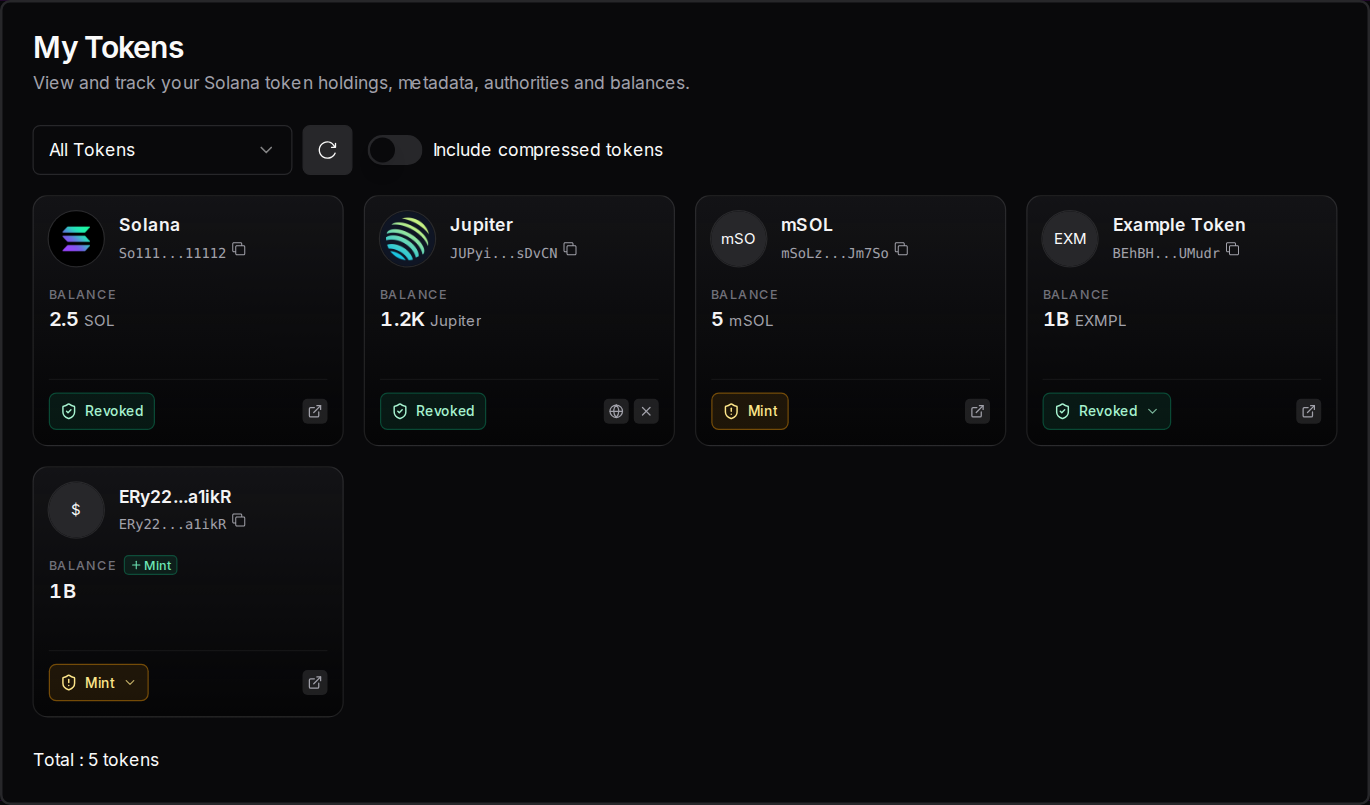
- Check tokens you hold. Connect your wallet to Solz.app and open My Tokens. Each token shows Revoked, or lists the keys that are still active.
- Make a practice token. Switch Solz.app to Devnet at the bottom right, open the Solana Token Creator, turn on Revoke freeze and Revoke mint, and approve.
This wallet holds four tokens. Jupiter, mSOL and Bonk show their names and logos, because they have metadata. The fourth has none, so it shows up only by its address, with a balance of 1B and no symbol. It's still a real token: it just has no label yet.
What should I expect to see?
On an explorer, a token with revoked keys shows no mint or freeze authority, while one that kept them shows an address. In Solz.app's My Tokens, a token shows Revoked or lists its active keys, such as Mint · Freeze. A token with no metadata shows up as just an address, with no name or logo.
| What you see | What it means | What to do |
|---|---|---|
| Revoked in My Tokens | Nobody can print more or freeze it | Nothing else |
| Mint, Freeze or Mint · Freeze in My Tokens | Those keys are still active | If it's your token, revoke them from the list. If it isn't, find out why they're kept |
| A token shown only by its address, with no symbol | It has no metadata, or your wallet can't read it | See fix a token that isn't showing |
| A name you know, but a different address | It's a copycat | Don't buy it |
How much does a token cost?
Holding one costs a refundable 0.00148844 SOL deposit for its token account, usually paid by whoever creates the box. Creating your own on Solz.app costs a 0.05 SOL service fee, plus about 0.016 SOL of network fees and rent, including Metaplex's metadata fee. Revoking freeze and mint while you create it is free.
| Item | Cost |
|---|---|
| Token account deposit | 0.00148844 SOL, refundable when the account is closed |
| Create a token on Solz.app | 0.05 SOL service fee |
| Network fees and rent to create it | About 0.016 SOL, including Metaplex's 0.01 SOL metadata fee |
| Revoke freeze or mint at creation | No extra fee |
| Revoke mint or freeze later | 0.04 SOL each |
FAQ
Is a token the same as a coin?
People use both words. Strictly, SOL is Solana's coin and everything else is a token, but a memecoin is a token too.
Can I see who holds a token?
Yes. An explorer's Holders tab lists the wallets that hold it and how much. Pools, bonding curves and exchanges often show up near the top, and that's normal.
Why doesn't my token show up in my wallet?
Usually its metadata is missing or your wallet hides unknown tokens. Fix a token that isn't showing covers each case.
What's Token-2022?
A newer token program with optional extras, such as a fee on every transfer. Pump.fun coins are Token-2022 mints, and tax tokens use it for their fee.
Can I change my token's supply later?
Only while you still hold the mint authority. Once it's revoked, the supply can only go down, when holders burn tokens.
Keep reading
Next in the beginner series: liquidity pools and bonding curves, or how a token gets a price.