
Solana for beginners: what Solana, SOL and a wallet actually are
New here? Good. This is the first of six short articles that explain Solana from zero, with drawings, everyday comparisons and as few long words as we could manage. Nothing here is financial advice, and crypto can lose all of the money you put in.
What is Solana, in plain words?
Solana is a giant shared notebook. Thousands of computers around the world each keep an identical copy, and together they add a new page about every 0.4 seconds. Nobody owns the notebook, so nobody can quietly rub out your line. SOL is the money you pay with to write in it.
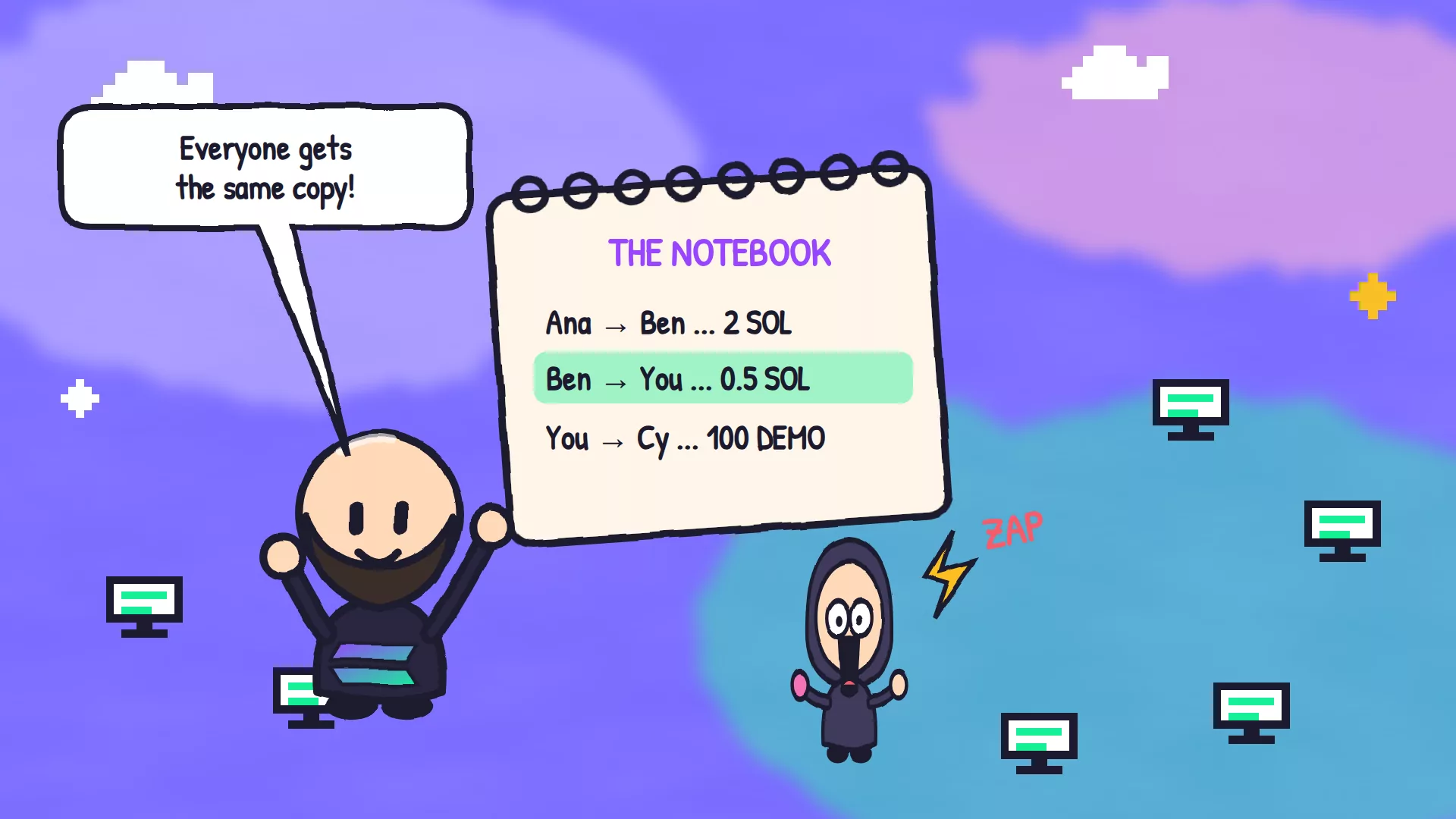
Every line says something like "Ben sent you 0.5 SOL". Before a line goes in, the computers check that Ben really had 0.5 SOL and that Ben signed it himself. Once it's in, it stays in. Changing an old line would mean getting most of those computers to agree to the same lie at the same moment, which is the whole point.
- The computers are called validators. Companies and individuals all over the world run them, and they're paid in SOL for keeping the notebook honest.
- The pages are called blocks. That's where the word blockchain comes from: each page is chained to the one before it.
- Nobody can stop your line going in, as long as it's signed and you can pay the fee. Nobody can take it out afterwards, either, including you.
What is SOL?
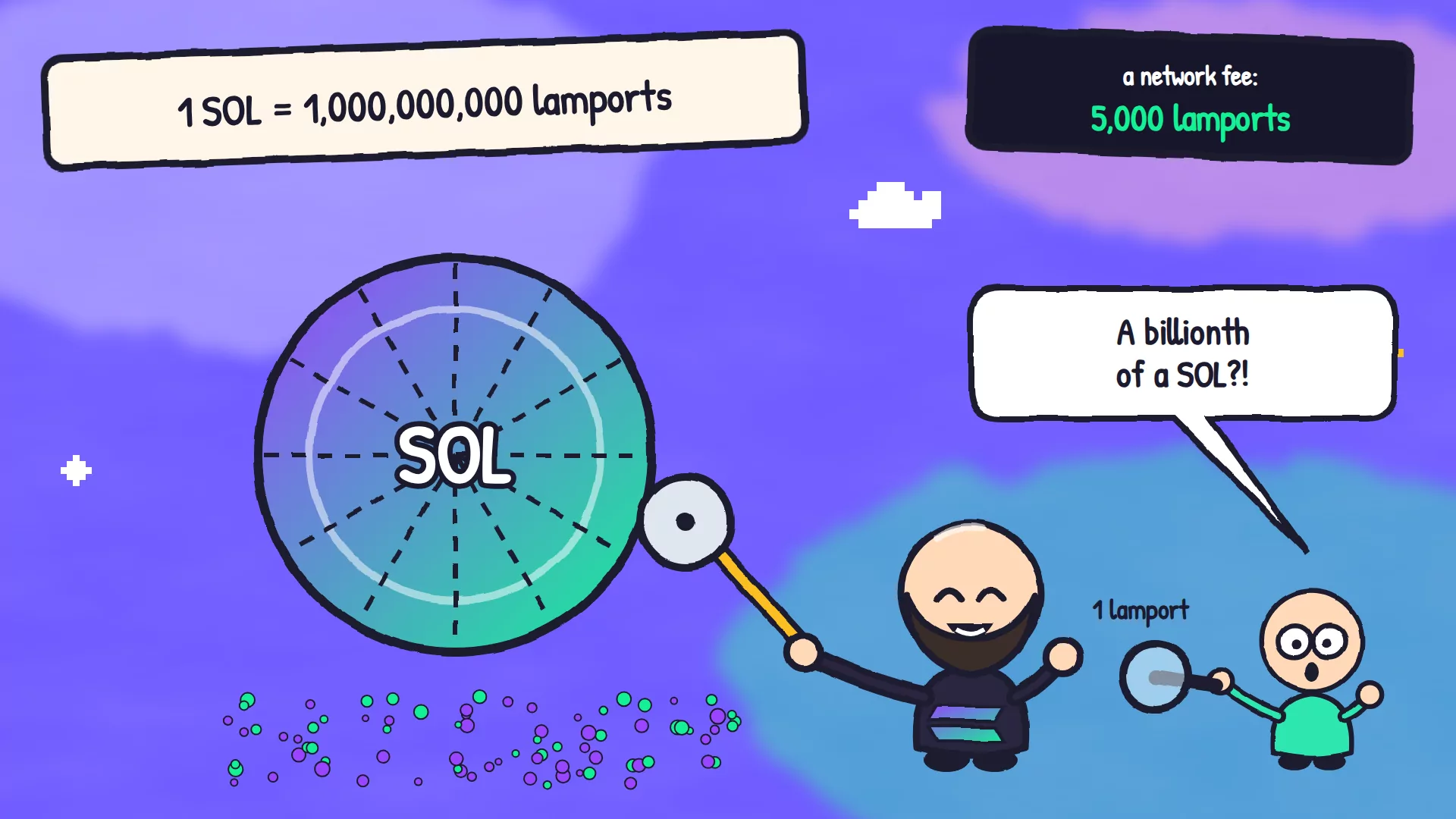
SOL is Solana's own coin, and you need a little of it to do anything. Every transaction pays a small fee in SOL, 0.000005 SOL per signature, plus an optional priority fee to go faster. One SOL splits into a billion pieces called lamports, so tiny amounts like 0.000005 SOL are perfectly normal.
SOL's price moves all day, like any currency on a market, so Solz.app quotes its costs in SOL, not dollars. Everything else you can hold on Solana, from USDC to memecoins, is a token, and tokens get their own article.
What's a wallet?
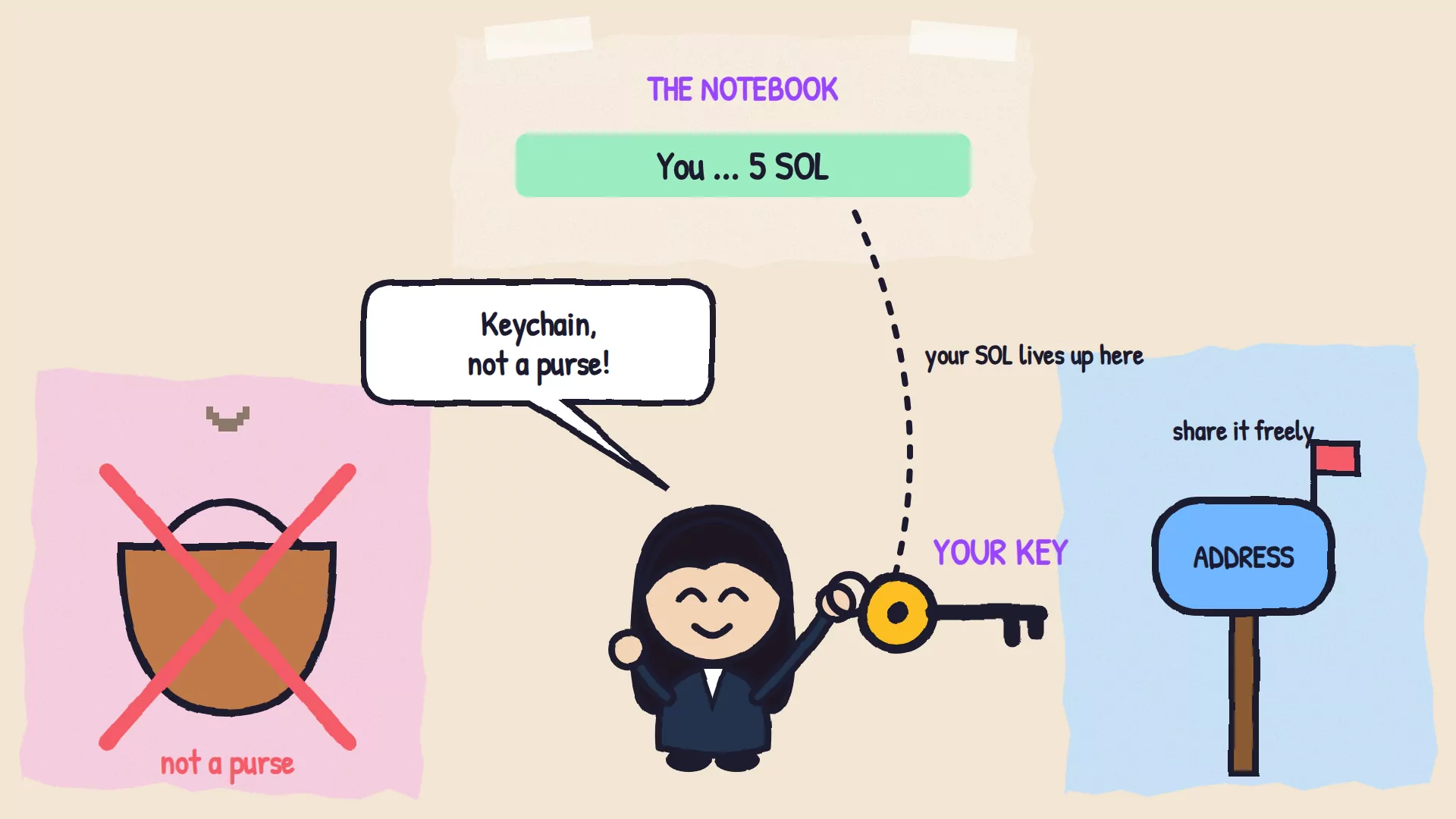
A wallet is a keychain, not a purse. Your SOL and tokens live in the notebook, under your address, and the wallet holds the key that lets you sign for them. Your address is like an email address: share it freely. The key is like the only password in the world, with no reset button.
- Wallet apps such as Phantom, Solflare and Backpack run as a browser extension or a phone app. They're free.
- Your address is a string of 32 to 44 letters and numbers. It's what people send SOL to, and anyone can look up what it holds.
- Connecting a wallet to a site like Solz.app only shows the site your address. Whenever the site wants to do something, your wallet opens and asks you to approve it. Approving is signing, so read what you're approving.
Why do my 12 words matter more than any password?
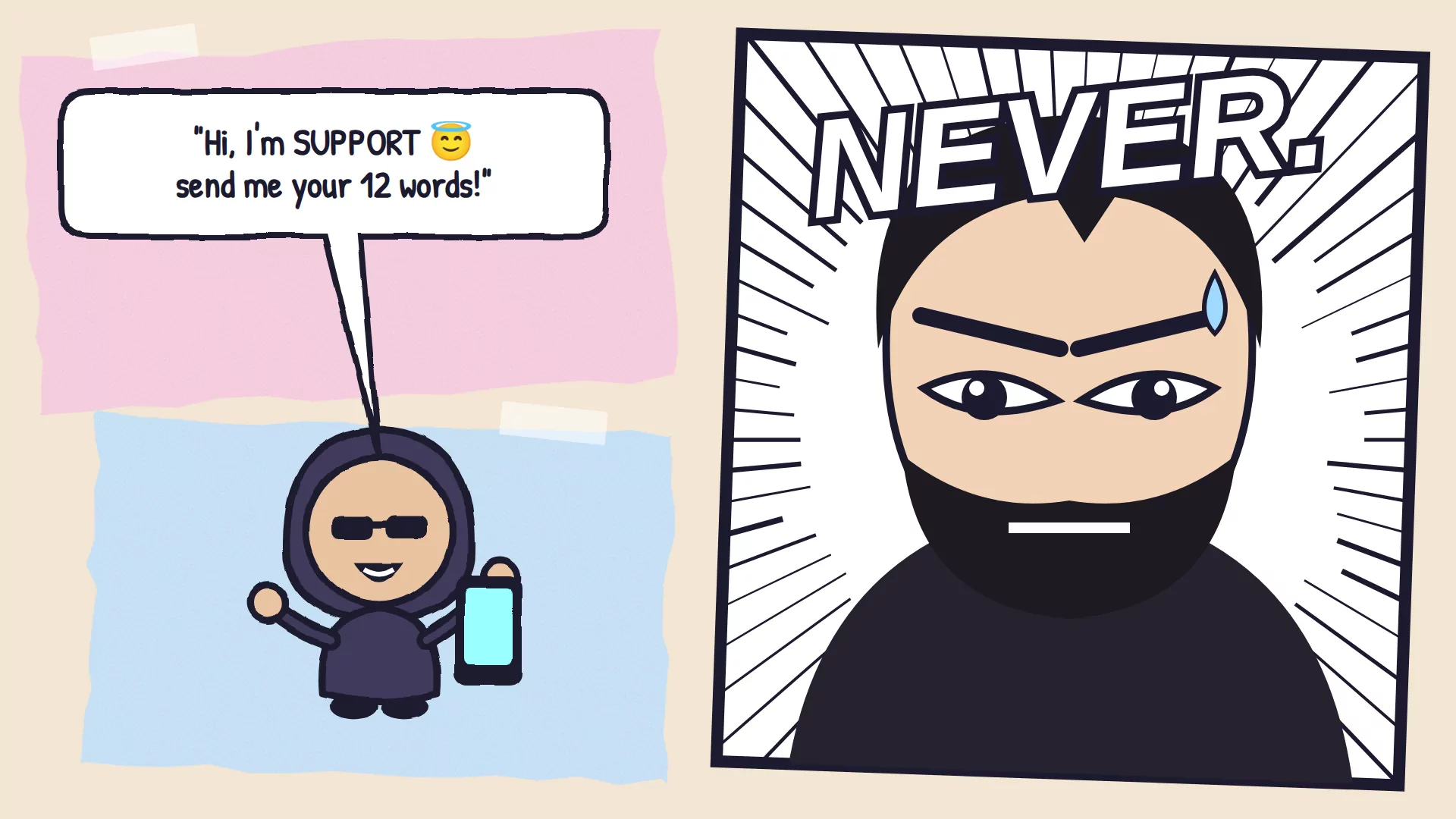
Your 12 words, called a seed phrase or recovery phrase, are your wallet's master key. Anyone who has them can rebuild your wallet on their own phone and empty it, and nothing can undo that. No real support team, exchange or app will ever ask for them. Write them on paper and keep them offline.
This part has no jokes, because it's how most people lose everything:
- Never type your words into a website, a form or a chat. The only place they ever go is your wallet app, and only when you're restoring your own wallet.
- Never photograph them or keep them in a cloud note. Paper in a safe place is better than anything with an internet connection.
- Anyone who messages you first offering help is a scammer. That includes "support", "admins" and "wallet recovery" services. Real help never starts in your DMs.
- Lose the words and the device, and the wallet is gone for good. There's no "forgot password" link, because there's nobody to send it.
- Some wallets use 24 words instead of 12. The rules are the same.
Prerequisites
- A phone or computer with a web browser.
- A pen and paper for your 12 words.
- About 15 minutes. You don't need any SOL to practise, because Devnet SOL is free.
Steps to get started on Solana
- Install a wallet. Get Phantom, Solflare or Backpack from its official website or your phone's app store. Check the developer's name first, because copycat apps exist.
- Create a wallet and write down your words. Write all 12 on paper, in order, and store it somewhere safe. The app may ask you to confirm a few of them.
- Copy your address. In your wallet, tap Receive, or tap your account name. That's the address people send SOL to.
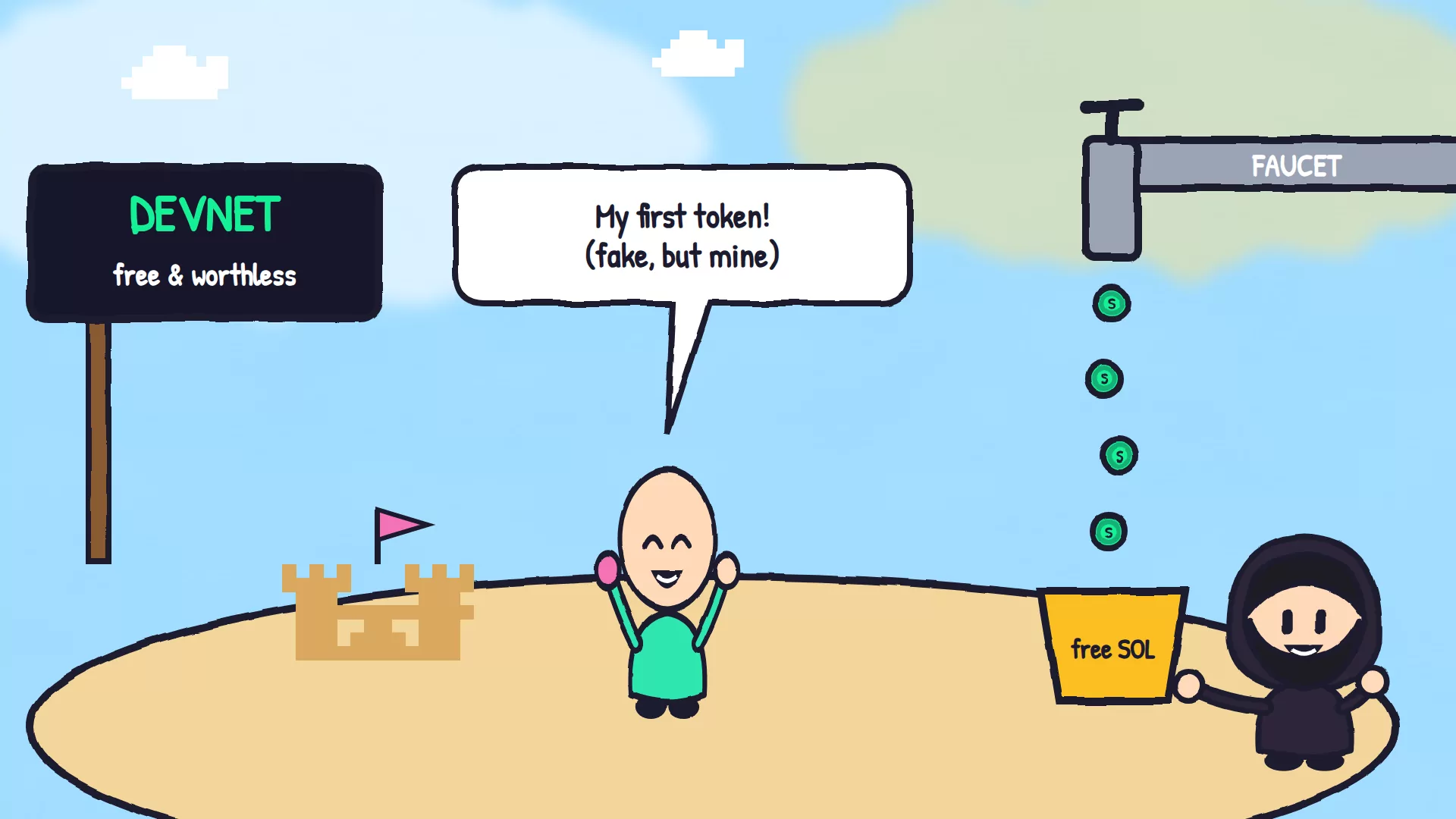
- Switch to Devnet to practise. Devnet is Solana's practice notebook. It has the same rules, but its SOL is free and worth nothing. Turn it on in your wallet's settings, often under Developer settings, then get free Devnet SOL from the Solana faucet.
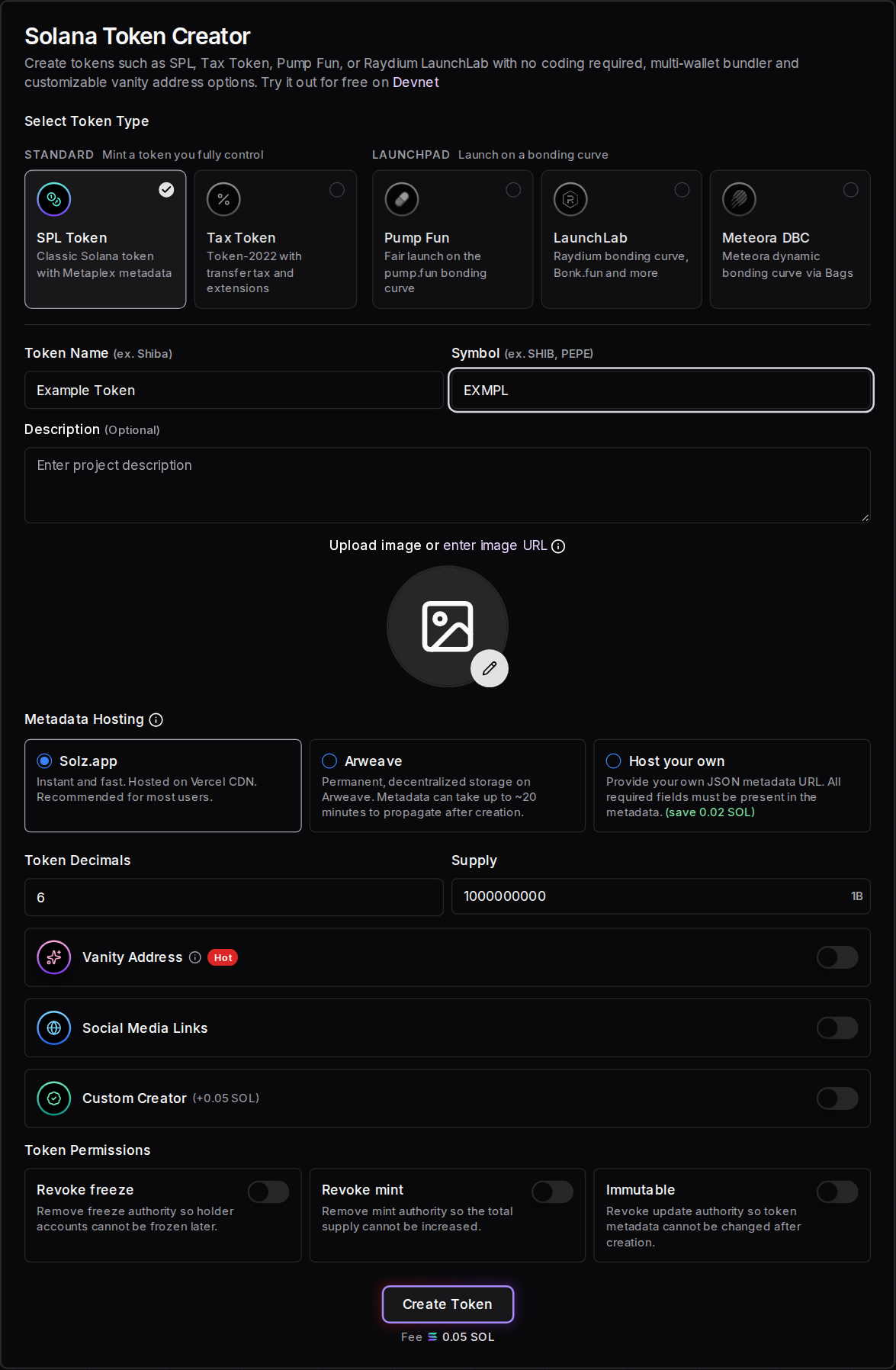
- Make a practice token. On Solz.app, switch to Devnet with the network selector at the bottom right, open the Solana Token Creator, fill it in and approve. It only costs Devnet SOL.
- Get real SOL when you're ready. Getting money in and out walks you through it, including the network you need to choose.
This is the Token Creator filled in for USELESS COIN, with 6 decimals and a supply of 1 billion, and with Revoke freeze and Revoke mint turned on. On Devnet, its 0.05 SOL fee is paid in free Devnet SOL:
What should I expect to see?
When a site asks for something, your wallet opens a window showing what will happen and the network fee. Approve, and Solana confirms it in a few seconds: your balance updates and the app shows a success message with a link to the transaction. Reject it, or run short of SOL, and nothing changes.
| What you see | What it means | What to do |
|---|---|---|
| Your wallet opens and asks you to approve | A site wants you to sign something | Read it, and approve only what you meant to do |
| A success message with a Solscan link | Your line is in the notebook for good | Nothing else. The link shows it to anyone |
| Not enough balance, you need at least the amount shown | You can't cover the cost and the fees | Add a little SOL, or Devnet SOL on Devnet |
| A message that your transaction expired before it was confirmed | It wasn't processed, so nothing changed | Raise the speed setting at the top of Solz.app and try again |
| A warning from your wallet that a site may be unsafe | Your wallet recognises a known scam site | Close the site. Don't approve anything |
How much does using Solana cost?
Sending SOL or a token costs a network fee of 0.000005 SOL per signature, plus any priority fee you choose. The first time you hold a new token, a refundable deposit of 0.00148844 SOL goes into its token account. Devnet costs nothing real. Creating things, like tokens or pools, adds the tool's own fee.
| Item | Cost |
|---|---|
| Network base fee | 0.000005 SOL per signature |
| Priority fee | Optional, set in your wallet or the app |
| Deposit for each token account | 0.00148844 SOL, refundable when the account is closed |
| Devnet SOL | Free, from the Solana faucet |
| Create a token on Solz.app | 0.05 SOL service fee, plus about 0.016 SOL of network fees and rent |
FAQ
Can I undo a transaction?
No. Once it's in the notebook, it's there for good. Nobody can reverse it, Solz.app included, so check the address and amount before you approve.
Is Devnet SOL worth anything?
No, and that's the point. You get it free from a faucet, so anyone selling you Devnet SOL is scamming you.
Someone on Telegram offered to help recover my wallet. Should I let them?
No. "Recovery" helpers who contact you first are scammers. They'll ask for your 12 words or a fee, and take both. Solz.app will never ask for your 12 words or your private keys.
Is Solana the same as Bitcoin?
Same idea, different notebook. Each runs its own network and its own coin, so SOL can't be sent to a Bitcoin address, or the other way round. That's why picking the right network matters when you move money in and out.
Do I need to understand all this to use Solz.app?
No. Solz.app's forms do the technical parts for you. Knowing what you're signing is what keeps you safe, though, and that's what this series is for.
The beginner series
- Solana for beginners: Solana, SOL, wallets and your 12 words. You're here.
- What is a token? Supply, decimals, mint and freeze authorities, and where tokens live.
- Liquidity pools and bonding curves: how a token gets a price, and what graduating means.
- What is Jito? Bundles, tips and the express lane.
- What is a rug pull? The tricks, and the checklist to run before you buy.
- Money in and out: from your bank to your wallet and back, plus the SOL Incinerator.