
How to create a Raydium liquidity pool
Make your Solana token tradable by creating a Raydium CPMM or AMM pool in your browser. The total fees are 0.24 SOL, plus the liquidity you add.
How do I create a Raydium liquidity pool for my token?
Open Create Liquidity Pool on Solz, choose Raydium CPMM, and pick your token and a quote token such as SOL. Enter how much of each to add, because their ratio sets the launch price. Pick a fee tier, click Create Liquidity Pool and sign. Fees total 0.24 SOL, plus your liquidity.
Prerequisites
- A Solana wallet that holds the token you want to pair.
- The token amount and the quote amount you plan to add.
- At least about 0.30 SOL on top of any SOL you're adding. Solz checks this before it builds the transaction.
- For a Raydium AMM pool only: an OpenBook market ID. CPMM doesn't need one.
Steps to create your pool
- Open the tool and connect your wallet. Go to Create Liquidity Pool and connect the wallet that holds your token.
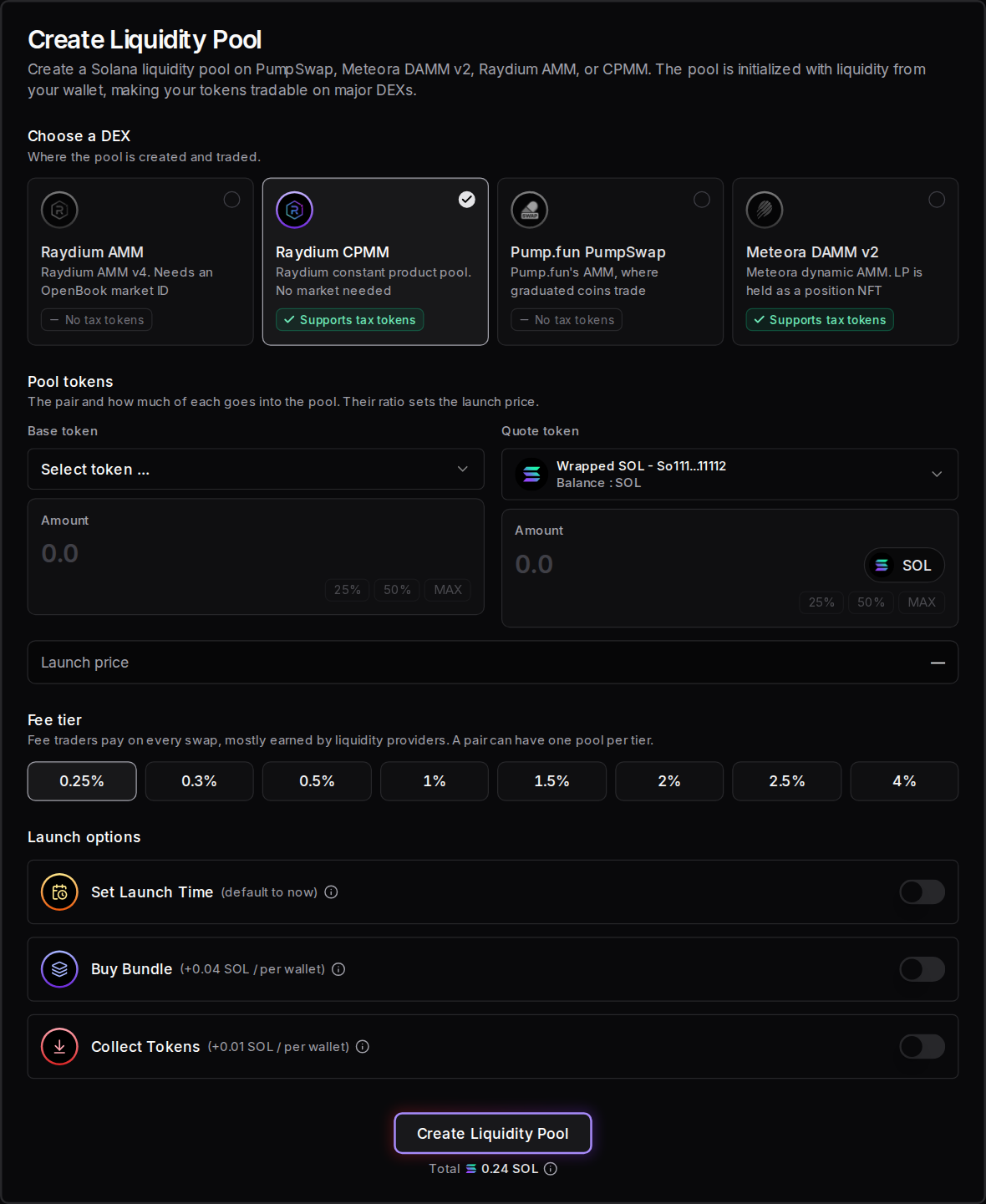
- Choose a DEX. Pick Raydium CPMM, the default. It needs no market and supports tax tokens. The comparison below explains when Raydium AMM might suit you instead.
- Choose the pool tokens. Select your token as the Base token and the token to pair it with as the Quote token.
- Enter the amounts. The ratio between them sets the launch price, which Solz shows before you submit. Check it carefully.
- Pick a fee tier. This is what traders pay on every swap, and it can't be changed later. Fee tiers are explained below. A pair can have one CPMM pool per tier, and Solz marks tiers that already have a pool.
- Set launch options if you need them. Set Launch Time opens trading at a chosen time instead of right away. Buy Bundle lets several wallets buy at launch. You can't use the two together.
- Create the pool. Check the cost shown on the button, click Create Liquidity Pool and approve in your wallet. The pool then appears under Your Liquidity Pools in this browser.
What is the difference between Raydium CPMM and AMM?
Both price tokens with the same constant product formula, so trading works the same way. The differences are around the pool. CPMM is Raydium's newer design, with a choice of fee tiers, tax token support and no OpenBook market. AMM v4 is the 2021 original, with one fixed 0.25% fee and standard SPL tokens only.
| Raydium CPMM | Raydium AMM (v4) | |
|---|---|---|
| Launched | June 2024 | February 2021 |
| Raydium's guidance | Recommended default | "Discouraged but accepted" |
| Pricing | Constant product (x × y = k) | Constant product (x × y = k) |
| Trading fee | 8 tiers on Solz, 0.25% to 4% | 0.25% only |
| Liquidity providers' share of the fee | 84% | 88% |
| Token-2022 and tax tokens | Supported | Not supported |
| OpenBook market ID on Solz | Not needed | Required |
| Cost on Solz before liquidity | 0.24 SOL | At least 0.62 SOL, including the market |
| Buy Bundle on Solz | Delayed, up to 3 seconds after launch | Same block: 4 wallets, then 5 per bundle |
| Raydium's own site | Creates these pools | No longer offers creating them |
At the same 0.25% fee, liquidity providers earn slightly more on AMM v4: 0.22% of each trade against 0.21% on CPMM.
Why does Solz default to CPMM?
CPMM is cheaper to create and works with more tokens, and it's what Raydium itself recommends for new pools. It needs no OpenBook market, accepts tax tokens, and lets you choose a fee tier. AMM v4 mainly makes sense if you specifically want same-block bundles, which CPMM can't offer on Solz.
- Lower cost: an AMM pool on Solz needs an OpenBook market first. That adds a 0.09 SOL service fee and at least 0.29 SOL of market costs.
- The market no longer does anything for trading: Raydium removed OpenBook from AMM v4 in July 2026, so swaps only use the pool. Solz's form still asks for a market ID.
- Tax tokens work: a Token-2022 token can't go in an AMM v4 pool.
- Fee choice: you can price the pool for your token instead of accepting 0.25%.
- Future support: Raydium describes AMM v4 as getting bug fixes only, with new features going elsewhere.
Choose AMM v4 if you want a same-block Buy Bundle, or if your pair already has a deep AMM v4 pool you'd rather not split liquidity from. Existing AMM v4 pools aren't going away: Raydium says AMM v4 isn't deprecated, and many are still active.
What is the history of Raydium AMM?
AMM v4 launched in February 2021 as a hybrid: a normal liquidity pool that also placed orders on Serum's order book, later OpenBook. Raydium announced CPMM as its replacement in March 2024 and removed the order book code from AMM v4 in July 2026. AMM v4 pools keep trading today as plain liquidity pools.
These dates come from Raydium's own timeline:
| Date | What happened |
|---|---|
| February 2021 | AMM v4 launches on Solana, sharing its liquidity with Serum's order book |
| August 2022 | Raydium launches CLMM, a separate concentrated liquidity pool type |
| Late 2022 | OpenBook forks Serum, and AMM v4 carries on against OpenBook |
| December 2022 | A pool authority key is compromised and several pools are drained. Raydium reports a key management failure rather than a program bug, moves authority to a multisig and compensates affected providers |
| March 2024 | Raydium announces CPMM as AMM v4's long-term replacement |
| June 2024 | CPMM goes live and is recommended for new pools |
| January 2025 | More liquidity sits in CPMM than in AMM v4, as providers migrate |
| July 2026 | Raydium removes the dormant OpenBook code from AMM v4. It had stopped sharing liquidity with the order book years earlier |
Raydium gave three reasons for replacing AMM v4: the OpenBook dependency complicated integrations, its fee structure rewarded liquidity providers less well, and it can't support Token-2022.
How do Raydium trading fee tiers work?
A fee tier is the percentage traders pay on every swap in your pool. You choose it once, when you create a CPMM pool, and it can't be changed later. On Raydium's current settings, liquidity providers receive 84% of that fee, and the other 16% funds RAY buybacks and Raydium's treasury. Solz takes none of it.
Here's how each tier on Solz splits a 1,000 USDC trade:
| Fee tier | Trader pays | Liquidity providers (84%) | RAY buybacks (12%) | Raydium treasury (4%) |
|---|---|---|---|---|
| 0.25% | 2.50 USDC | 2.10 USDC | 0.30 USDC | 0.10 USDC |
| 0.3% | 3.00 USDC | 2.52 USDC | 0.36 USDC | 0.12 USDC |
| 0.5% | 5.00 USDC | 4.20 USDC | 0.60 USDC | 0.20 USDC |
| 1% | 10.00 USDC | 8.40 USDC | 1.20 USDC | 0.40 USDC |
| 1.5% | 15.00 USDC | 12.60 USDC | 1.80 USDC | 0.60 USDC |
| 2% | 20.00 USDC | 16.80 USDC | 2.40 USDC | 0.80 USDC |
| 2.5% | 25.00 USDC | 21.00 USDC | 3.00 USDC | 1.00 USDC |
| 4% | 40.00 USDC | 33.60 USDC | 4.80 USDC | 1.60 USDC |
The rates come from Raydium's live pool configs, read on 2026-11-01. Raydium can add tiers, and it has more on-chain than Solz shows.
What is the fee used for?
- Paying liquidity providers. This is the reward for putting tokens in the pool, and for the risk of the price moving against them. Their share stays in the pool, so each LP token gradually becomes worth more. They collect it when they withdraw, not as separate payments.
- Funding Raydium. The rest buys RAY and goes to Raydium's treasury.
As the pool creator, you only earn from the fee through the LP tokens you hold. If you burn your LP tokens, you can no longer withdraw that liquidity, so you give up its share of the fees too.
CPMM also has an optional creator fee, charged on top of the tier and set to 0.05% on the tiers Solz shows. Pools created on Solz leave it off, so traders pay only the tier and there's no creator fee to claim.
Which tier should you choose?
A higher tier earns more per trade, but it can put traders off. Raydium's guidance is 0.25% for major volatile pairs and 1% for memecoins and other low-liquidity pairs. It also warns that a pair with plenty of trading can earn more at 0.25% than at 1%, because the higher fee can reduce volume.
- Traders compare net prices. A high fee makes your pool a worse deal than a cheaper pool for the same pair.
- More pools split your liquidity. A pair can have one pool per tier, so changing your mind means a new pool, and liquidity spread across two pools moves the price more per trade.
- Tax tokens pay twice. A Token-2022 transfer fee is separate from the pool's fee, so traders pay both.
How much does it cost to create a Raydium pool on Solz?
Creating a Raydium pool costs 0.09 SOL in Solz service fees and 0.15 SOL in Raydium fees, for 0.24 SOL in total. You also need the liquidity you're adding, and Solz checks for a further 0.06 SOL allowance for token accounts. Buy Bundle and Collect Tokens cost extra per wallet.
| Item | Cost |
|---|---|
| Service fee | 0.09 SOL |
| Raydium CPMM or AMM fee | 0.15 SOL |
| Token account allowance in the balance check | 0.06 SOL |
| OpenBook market, Raydium AMM only | 0.09 SOL service fee, plus 0.29 SOL or more in market costs |
| Your liquidity | The amounts you enter |
| Buy Bundle (optional) | +0.04 SOL per wallet |
| Collect Tokens (optional, with Buy Bundle) | +0.01 SOL per wallet |
FAQ
Can I change the fee tier after creating the pool?
No. The tier is set when the pool is created. To use a different tier, you'd create another pool for the pair on that tier and move your liquidity to it.
Do I need an OpenBook market for CPMM?
No. Only Raydium AMM pools ask for a market ID on Solz.
Can I create a pool somewhere other than Raydium?
Yes. The same tool creates PumpSwap and Meteora DAMM v2 pools. They have the same 0.09 SOL service fee and no Raydium fee, and the balance check uses a 0.03 SOL token account allowance instead.
Why does Solz say I don't own the token pair?
Your connected wallet needs to hold the tokens you're adding. Switch to the wallet that holds them, or check that you selected the right token.
When will my token show up on other sites?
Once liquidity is live, your token can appear on Jupiter, Raydium, Photon, DexScreener and similar platforms. Those sites decide when and how to list it.
What should I do with my LP tokens?
They're how you withdraw your liquidity later, so keep them safe. To show buyers that the liquidity can't be pulled, you can burn them for good, or lock them until a date with Token Lock.
Sources
Solz's fees and form options come from the app. The rest comes from Raydium:
- History and milestones
- Versions and migration
- AMM v4 OpenBook removal
- Protocol fees
- CPMM fees
- Choosing a pool type
Open the tool
How to get a Solana vanity address for a token or wallet
Generate a Solana address with letters you choose, using Solz's hosted GPU generator. Use it for token branding, to market an address before launch, or as a wallet.
How to burn liquidity pool (LP) tokens on Solana
Burn part or all of your liquidity pool (LP) tokens on Solz, finish a full burn with the SOL Incinerator, get the DexScreener lock, and compare burning with Token Lock.