
Liquidity pools and bonding curves explained, with a vending machine
This is part of the beginner series. It assumes you know what a token is.
What is a liquidity pool?
A liquidity pool is a vending machine with two jars inside: one of a token and one of SOL. Put SOL in and tokens come out. Put tokens in and SOL comes out. Nobody sets the price by hand: the machine works it out from how full the two jars are.
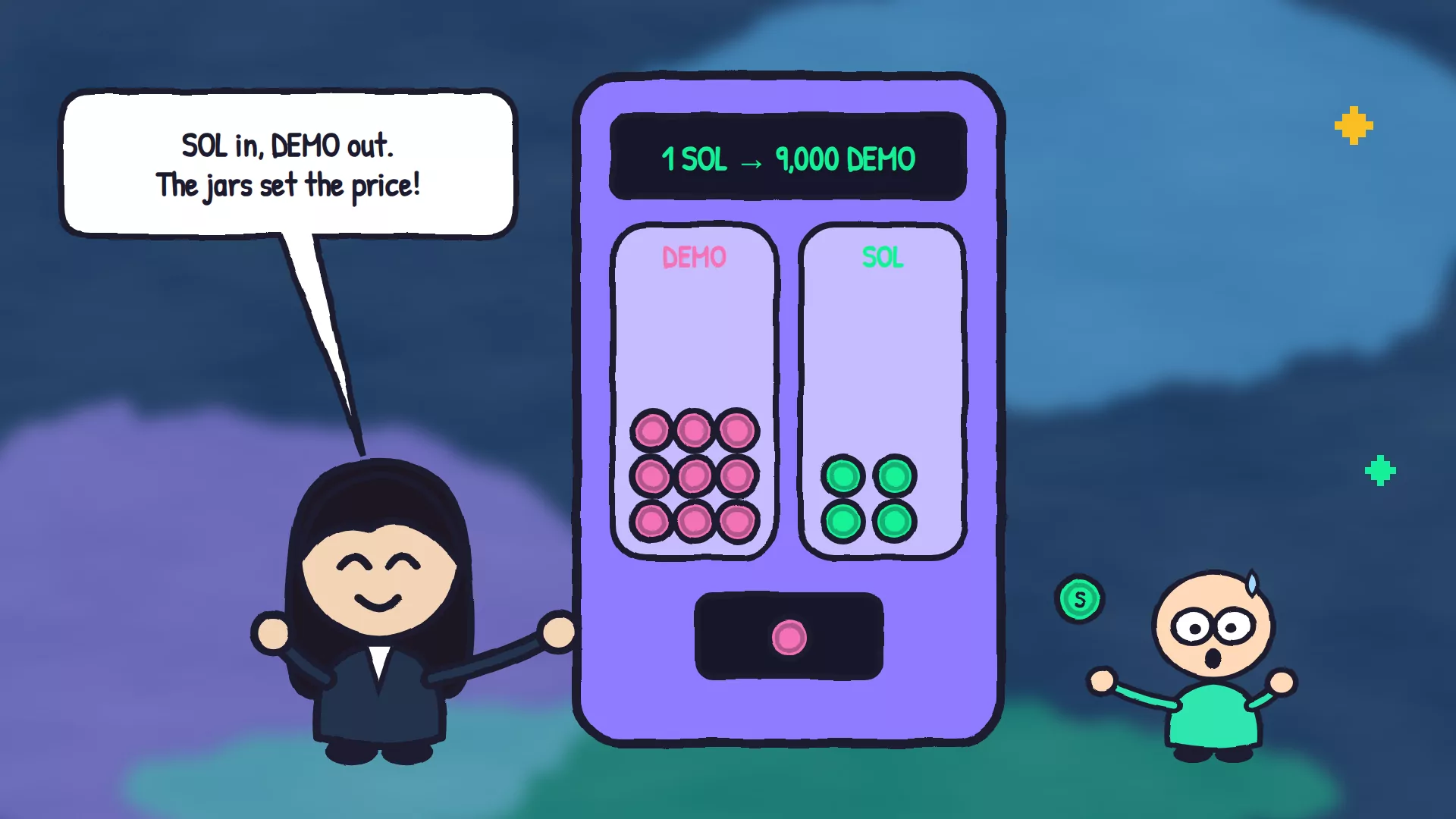
Whoever fills the jars first is called a liquidity provider, and it's usually the token's creator. No machine means no sales, however good the logo is. That's why "add liquidity" is the step that turns a token into something people can actually buy.
How does a pool set the price?
The price is simply one jar divided by the other. A pool holding 5,000 USELESS and 6.77665 SOL prices each USELESS at 0.00135533 SOL. Every buy takes tokens out and puts SOL in, so the next token costs more. Big buys move the price a lot, and small pools move fastest.
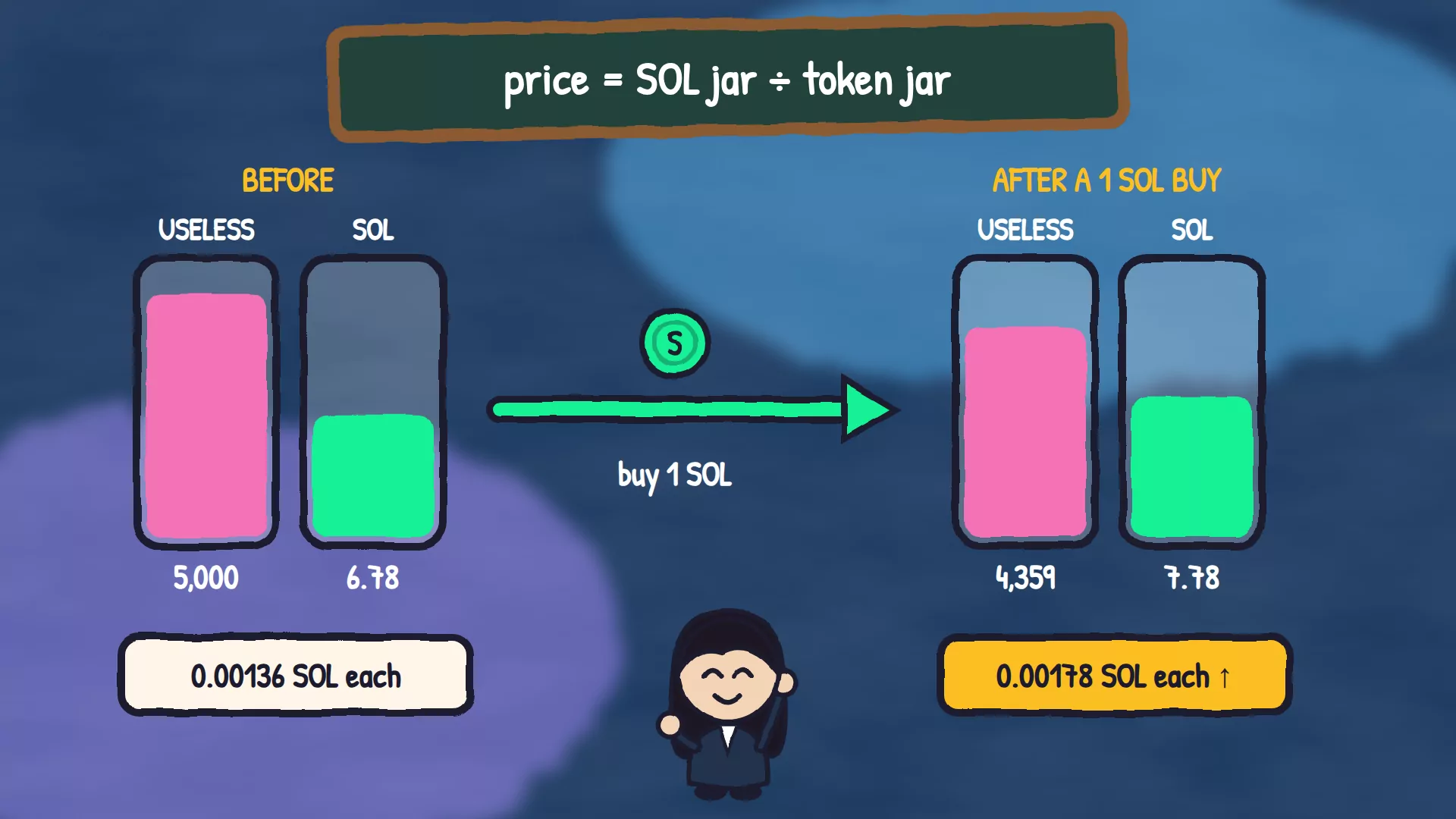
Most standard pools follow one rule: the two jars multiplied together stay the same after every trade, apart from the fees. Here's what buying from that pool does, after its 0.3% trading fee:
| You spend | You get | Your average price | The price afterwards |
|---|---|---|---|
| 0.1 SOL | About 72.5 USELESS | 0.00137941 SOL | 0.0013955 SOL |
| 1 SOL | About 641.3 USELESS | 0.00155941 SOL | 0.00178347 SOL |
The 1 SOL buyer paid about 15% more per token than the starting price, because their own buy kept raising it as it went. That's called price impact, and it's why a pool with only a few SOL in it swings so wildly.
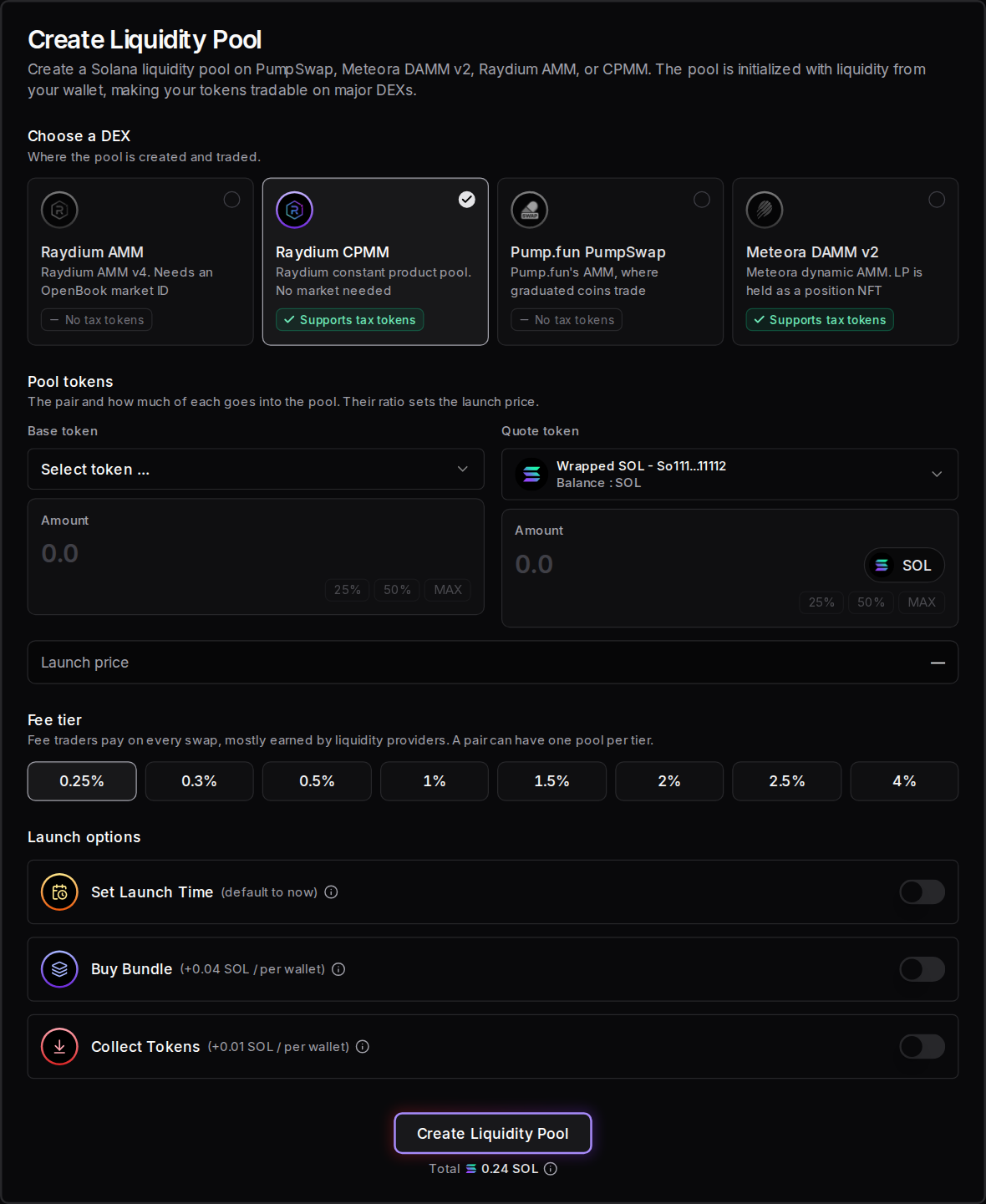
This is that pool on Solz.app's Create Liquidity Pool form. The wallet entered 5,000 USELESS at the market price, and Solz.app filled in 6.77665 SOL:
What is slippage?
Slippage is the gap between the price you see and the price you get. Between clicking Buy and your trade landing, other people's trades can move the jars. A slippage limit, such as 1%, tells your trade to cancel itself rather than fill at a price worse than that.
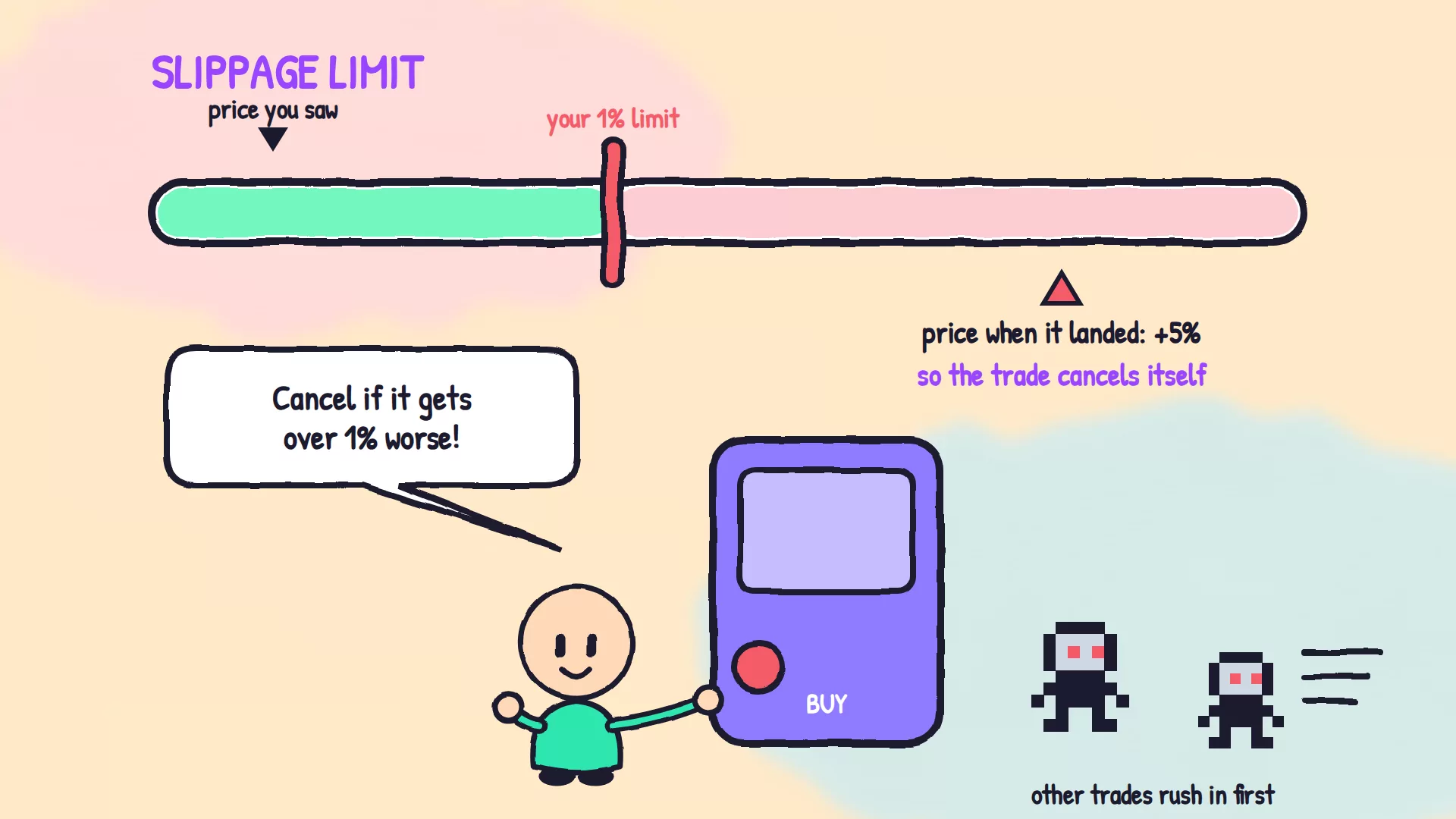
- Too low, and busy tokens keep failing your trades. A failed trade still costs the small network fee.
- Too high, and you can get a much worse price than you expected, especially from bots that trade just before and after you.
- Your own buy counts too. In a small pool, a big buy can blow through a 1% limit all by itself.
What are LP tokens?
LP tokens are the receipt you get for filling a pool's jars. They let you take your share of both jars back later, including your share of the trading fees. That's why buyers care about them: if the creator still holds the receipt, they can empty the machine at any time.
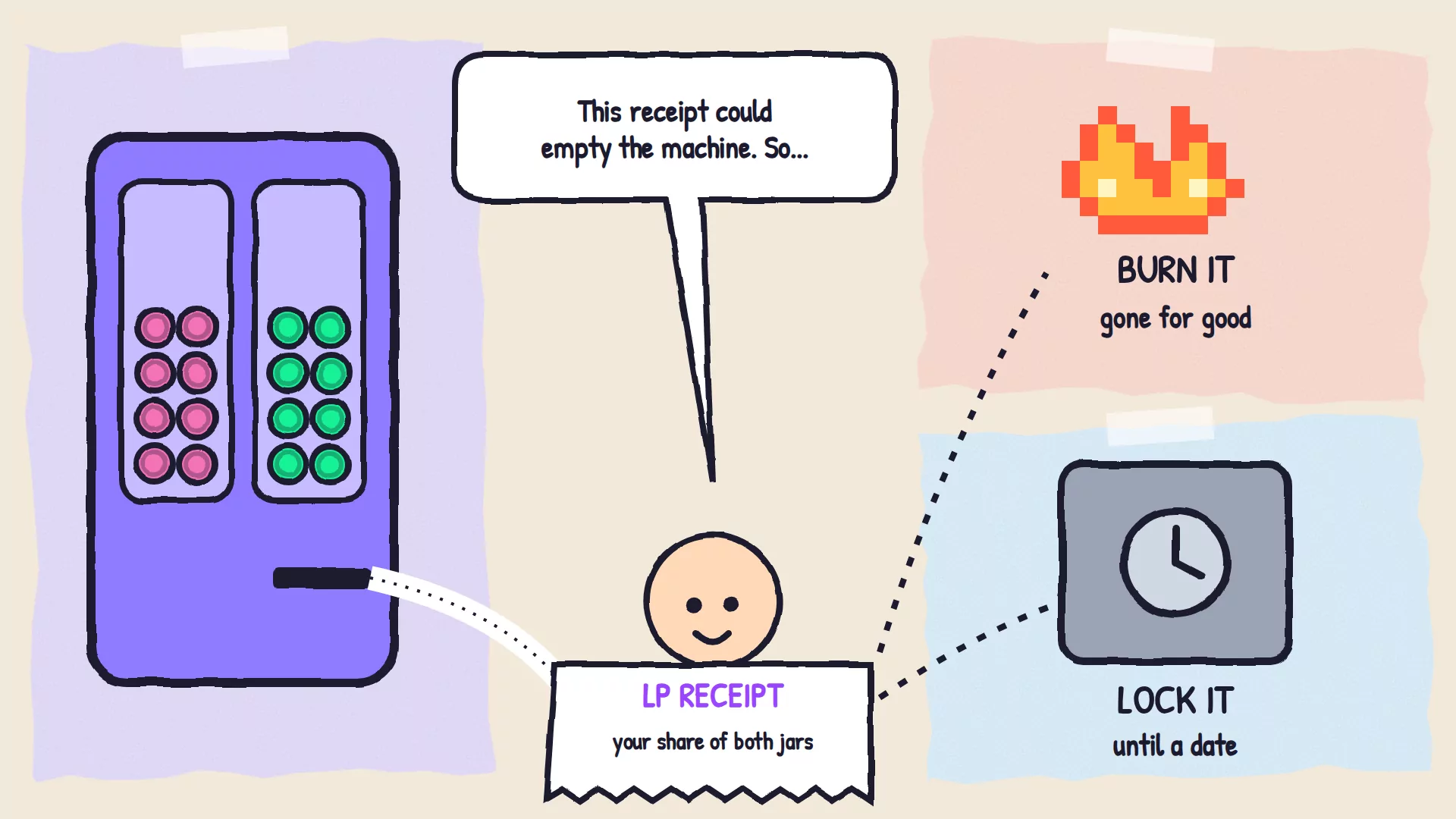
So a creator who wants to be trusted gets rid of the receipt. Burning LP tokens destroys it for good, and locking them puts it in a time-locked safe until a date everyone can see. Either way, buyers can check it on-chain.
What is a bonding curve?
A bonding curve is a vending machine that starts without a SOL jar. Instead, the price follows a fixed escalator: every buyer steps onto a slightly higher stair. Pump.fun, LaunchLab and Meteora DBC all work this way, so a creator can launch without supplying the liquidity themselves.
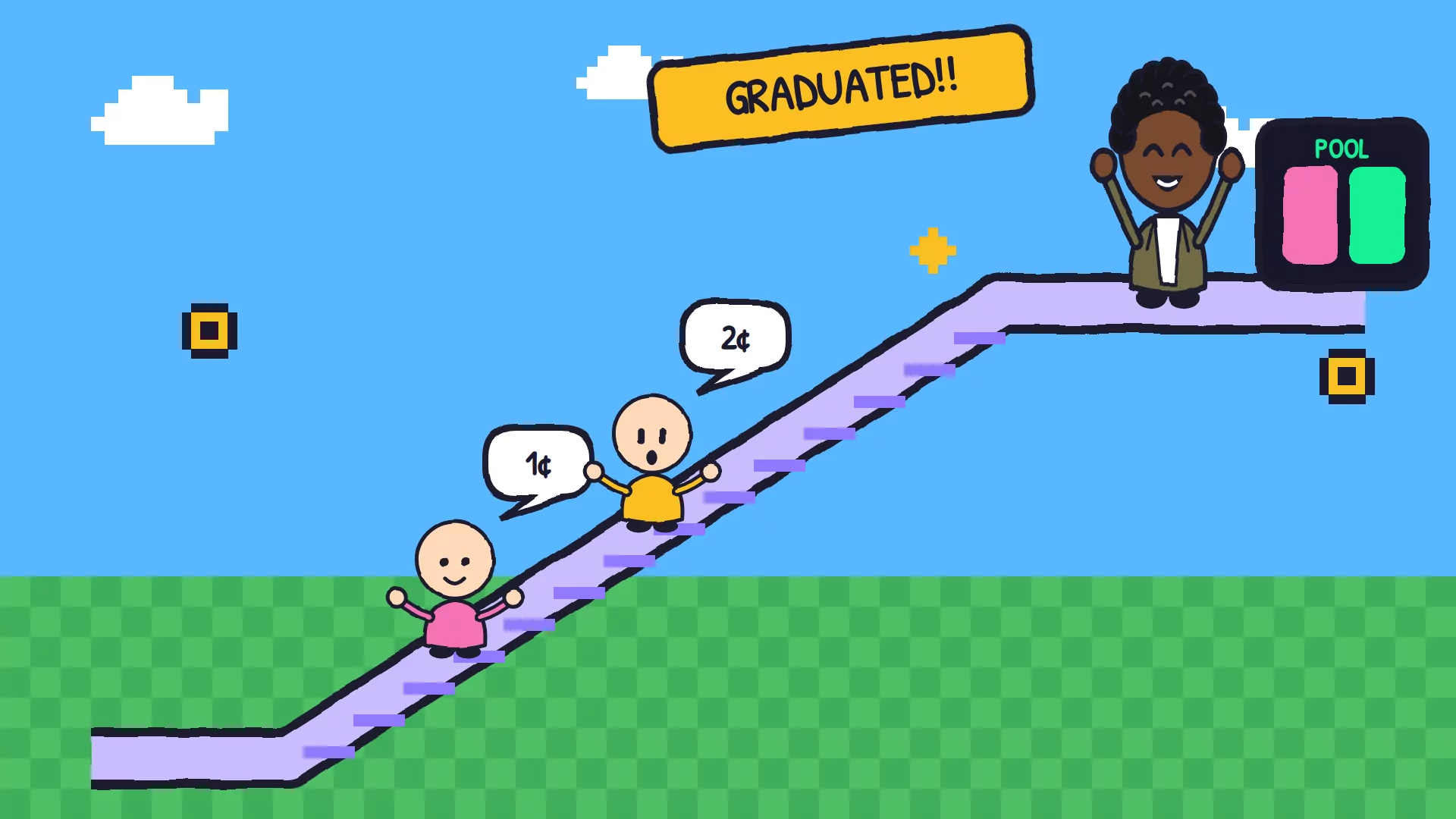
Early buyers get the cheap stairs, and every buy pushes the price up the curve. Sells push it back down. The curve is set before the launch, so everyone can see exactly what each stair costs.
What happens when a token graduates?
When enough SOL has gone up the escalator, the curve closes and the token graduates. Its SOL and remaining tokens move into a normal liquidity pool, and trading carries on there. On Pump.fun that happens at about 85 SOL, the new pool is on PumpSwap, and its LP tokens are burned automatically.
Most tokens never get there. The Block reported a Pump.fun graduation rate of 2.5% in one week, so treat graduation as the exception. Launch on Pump.fun has the full curve numbers.
Prerequisites
- A wallet with SOL, plus the token you want to pair if you're making a pool.
- A rough idea of the starting price you want, because the first deposit sets it.
- Optionally, a read of which launch type suits you.
Steps to create a liquidity pool
- Open the tool and connect your wallet. Go to Create Liquidity Pool and connect the wallet that holds your token.
- Keep Raydium CPMM selected. It's the default on Standard pools and works for most tokens.
- Pick your two tokens. Your token goes in Base token, and SOL in Quote token.
- Fill the jars. Enter both amounts, or set a launch price and one amount. The two amounts set the starting price, so check it carefully.
- Choose a fee tier. It's what every trader pays on each swap, and it can't be changed later.
- Review and approve. Check the total under the button, click Create Liquidity Pool and approve in your wallet.
To launch on a bonding curve instead, follow Launch on Pump.fun, Launch on LaunchLab or Launch on Meteora DBC.
What should I expect to see?
Before you approve, the form shows the starting price your amounts set and the total cost. When it works, Solz.app says CPMM Pool has been successfully created, and the pool appears in My Liquidity Pools. If you're short of SOL or the token, a red message says what you need before anything is sent.
| What you see | What it means | What to do |
|---|---|---|
| CPMM Pool has been successfully created | Your pool is live and anyone can trade | Decide whether to burn or lock your LP tokens |
| Not enough balance of USELESS, you have, followed by your balance | You entered more of the token than you hold | Lower the amount |
| This pair already has a pool at 0.25%. Add to it instead. | That fee tier is taken | Add to that pool, or pick another tier |
| A buyer's trade fails on slippage | The price moved past their limit | Nothing is wrong with the pool. Big moves are normal in small pools |
How much does a pool or a curve cost?
A Raydium CPMM pool on Solz.app costs a 0.06 SOL service fee and Raydium's 0.15 SOL fee, plus about 0.04 SOL of rent, before the liquidity you put in. A bonding curve launch costs a 0.05 SOL service fee plus network costs, and no liquidity, because buyers fill the curve. Traders pay each pool's or curve's trading fee.
| Item | Cost |
|---|---|
| Create a Raydium CPMM pool on Solz.app | 0.06 SOL service fee |
| Raydium's pool fee | 0.15 SOL |
| Network rent for the pool | About 0.04 SOL |
| Your liquidity | The amounts you put in both jars |
| Launch on a bonding curve, such as Pump.fun | 0.05 SOL service fee, plus network costs and your own buy if you make one |
| Trading fee on Pump.fun's curve | About 1.25% of each trade |
FAQ
Can I lose money by adding liquidity?
Yes. As people trade, your share of the jars shifts toward whichever side is falling in value, and if the token goes to zero, so does that side. Only add what you can afford to lose.
Why did I get fewer tokens than the quote?
The price moved between the quote and your trade, or your own buy moved it. Your slippage limit sets how much worse it's allowed to get.
Pool or bonding curve: which should I choose?
A pool if you have the SOL to supply liquidity and want control over the price and fees. A curve if you'd rather buyers fund it. Choose how to launch compares them side by side.
Who earns the trading fees?
In a pool, mostly the liquidity providers, with a share to the DEX. On a bonding curve, the launchpad and the creator split them. Each guide lists the exact split.
Keep reading
Next in the beginner series: what is Jito?, or how bundles get your launch and your first buys into the same block.