
Launch on Raydium LaunchLab with bundles and a vanity address
How do I launch a token on Raydium LaunchLab with Solz.app?
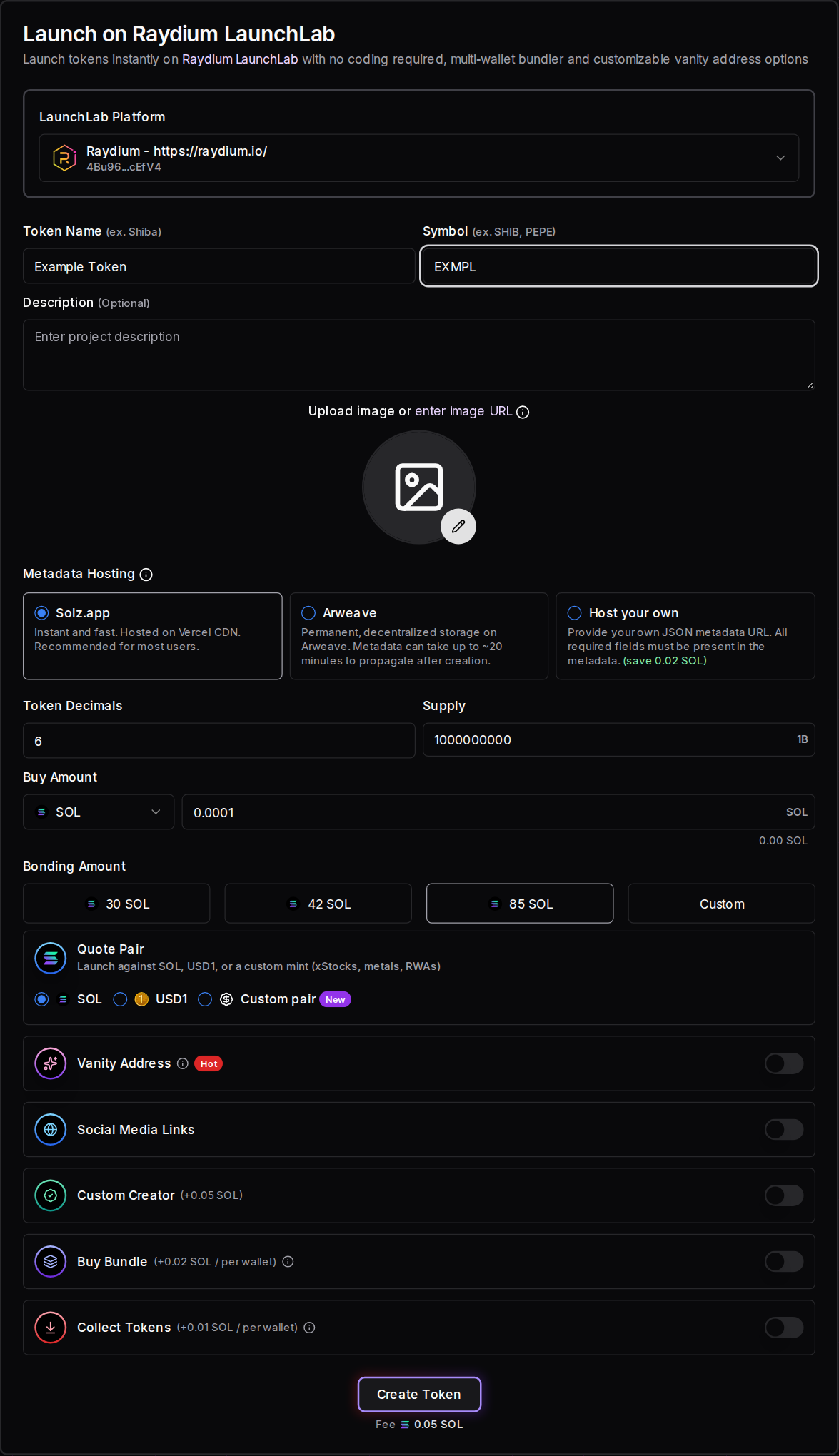
Open Launch on Raydium LaunchLab on Solz.app, connect your wallet, and enter a name, symbol and image. Choose a platform, Buy Amount, Quote Pair and Bonding Amount, then optionally add a vanity address and Buy Bundle. Click Create Token and sign. The Solz.app service fee is 0.05 SOL, and your buy costs extra.
LaunchLab is Raydium's token launchpad. A token trades on a bonding curve first, then moves to a Raydium pool once the curve sells out. If you'd rather earn from other people's launches, create your own LaunchLab platform. For a curve that graduates to Meteora instead, see Launch on Meteora DBC.
Prerequisites
- A Solana wallet such as Phantom, Solflare or Backpack.
- At least about 0.075 SOL, plus your Buy Amount and 1%. Solz.app checks this before it builds the launch.
- A token name, a symbol and an image.
- For a bundle: wallets in Manage X Wallets, each holding more than its buy, to cover fees.
- For a vanity address: a private key from the Vanity Address Generator.
Steps to launch on LaunchLab
- Open the tool and connect your wallet. Go to Launch on Raydium LaunchLab, under Raydium in the sidebar, and connect the wallet that will create the token.
- Choose the platform. LaunchLab Platform starts on Raydium. The platform decides the fees on your token. Compare them before you continue, or browse LaunchLab Platforms for others.
- Enter the token details. Fill in Token Name, Symbol, an optional Description, an image and any Social Media Links, and choose where the metadata is hosted.
- Check decimals and supply. Token Decimals and Supply start at 6 and 1 billion. A platform's rules can limit them.
- Set Buy Amount and Quote Pair. Buy Amount is what your connected wallet buys in the launch. Choose SOL, USD1 or a custom pair.
- Choose the Bonding Amount. Pick 30, 42 or 85 SOL, or set a custom amount. This is how much the curve raises before the token moves to a Raydium pool.
- Add a vanity address or Buy Bundle if you want them. Both are explained below.
- Launch the token. Check the total on the button, click Create Token, and approve in your wallet.
Bundle wallets are visible on-chain. Tell your community what your team holds, and check the rules that apply to you. Nothing here is financial advice, and a launch can lose all of the money you put in.
What should I see when a launch succeeds or fails?
When a launch works, Solz.app says Successfully deployed to, followed by the launchpad's name, and your new token appears in My Tokens. If your wallet is short, a red message gives the SOL you need, and nothing is sent. Other messages point to your buy amount, your bundle or a busy network.
In the example above, you launch with USELESS COIN's details on the Raydium platform, with a Buy Amount of 3 SOL and an 85 SOL Bonding Amount. Solz.app checks for about 3.105 SOL: about 0.075 SOL for fees and network costs, your buy, and 1% of it.
| What you see | What it means | What to do |
|---|---|---|
| Successfully deployed to Raydium LaunchLab, or to the launchpad you chose | Your token is live and your buy is included | Check it in My Tokens, then share it |
| Not enough balance, you need at least the amount shown (including gas + service fees) | You can't cover the fees and your buy | Add SOL, or lower your buy |
| Not enough USD1 balance to cover the buy amount, balance, followed by your balance | You chose a quote pair and don't hold enough of it. The symbol matches your pair | Add more of it, or lower your buy |
| Error in buy amount of the wallets | A bundle wallet can't cover its buy and fees | Add SOL to that wallet, or lower its buy |
| Transaction timeout ! This might be due to you sending invalid transactions / congested network | It didn't confirm in time | Check your wallet history before trying again, because it may have gone through. If not, raise your priority fee |
| Your transaction expired before it was confirmed | It wasn't processed | Raise your priority fee and try again |
What are the launch options?
Only the name, symbol and image are required. The other options change what your token costs to trade, how much it raises and how it launches. Most of them can't be changed after launch, so check the platform, Quote Pair and Bonding Amount carefully. Each option is explained below, including what it does on-chain.
LaunchLab Platform
Every LaunchLab token launches under a platform, which sets the fees and what happens to the liquidity after graduation. The form starts on Raydium's own platform. BonkFun and StonkFun launches on Solz.app are LaunchLab launches on those platforms, each with its own settings.
To find another platform, open LaunchLab Platforms, under Raydium in the sidebar. It lists the platforms with the most recent launches, each with its total trading fee and its newest tokens. Create Token on a platform opens this form with that platform chosen. You can also search the LaunchLab Platform list by Platform ID.
Bonding Amount
This is the main choice LaunchLab gives you that Pump.fun doesn't. A lower amount graduates sooner, but it starts at a lower price and moves into a thinner pool. The bonding curve section below shows the numbers. A platform's rules can restrict the amounts you can pick.
Quote Pair
This is what traders pay with, and it can't be changed after launch.
- SOL is the standard choice, and the numbers in this guide are for SOL.
- USD1 prices the curve in dollars. The default target is 12,500 USD1, with lower presets of 5,000 and 6,400.
- Custom pair launches against another supported mint, such as an xStock, metal or real-world asset token.
Metadata Hosting
Solz.app is instant and recommended for most users. Arweave is permanent, but can take about 20 minutes to appear. Host your own needs a JSON metadata URL, and saves 0.02 SOL.
Custom Creator
This adds your own creator name and website to the token's metadata for +0.05 SOL.
Vanity Address and Buy Bundle
These work the same way as on Pump.fun launches. See the sections below for what's different on LaunchLab.
What you can't choose
- Trading fees. These come from the platform and Raydium, as the trading fees section shows.
- Mint authority. Raydium's program holds it during the curve, and revokes it at graduation.
- Revoke switches. The token creator's Token Permissions switches don't appear on launchpad launches.
How does a buy bundle work on LaunchLab?
A Buy Bundle uses Jito MEV bundles so that several wallets can buy in the same Solana block as the launch. On LaunchLab, the first bundle holds up to 8 wallets and later bundles hold up to 10. Your launching wallet pays the 0.01 SOL per wallet bundle fee, and each wallet pays for its own buy.
- Custom pairs hold fewer. With a custom pair each transaction carries 1 wallet instead of 2, so bundles hold up to 4 wallets, then 5.
- Collect Tokens moves the tokens from the bundle wallets to one address afterwards, for +0.01 SOL per wallet.
- Jito tip: a bundle needs a tip of at least 0.0001 SOL.
- Keys: X Wallet keys stay in this browser only, so back them up in Manage X Wallets.
For a vanity address, turn on Vanity Address and use Load Private Key. The vanity guide explains how to generate one and what it costs.
How does the LaunchLab bonding curve work?
The curve sets the price automatically: each buy raises the price, and each sell lowers it. With the default 1 billion supply, 793.1 million tokens sell on the curve and 206.9 million go to the pool later. Your Bonding Amount decides how much SOL it takes to sell them, and so the starting price.
Raydium's default curve uses a constant product formula, where virtual SOL × virtual tokens stays the same on each trade. These values come from Raydium's live LaunchLab config and SDK:
| Bonding Amount | Starting virtual SOL | Market cap at the start | Market cap at graduation |
|---|---|---|---|
| 30 SOL | About 10.6 SOL | About 10 SOL | About 145 SOL |
| 42 SOL | About 14.8 SOL | About 14 SOL | About 203 SOL |
| 85 SOL | About 30 SOL | About 28 SOL | About 411 SOL |
All three start from about 1,073 million virtual tokens. The USD1 default of 12,500 starts from about 4,412 virtual USD1, with a market cap of about $4,100 at the start and $60,400 at graduation.
This is what the first buyer would get on Raydium's platform, after its 1.05% in trading fees:
| You spend | 30 SOL curve | 42 SOL curve | 85 SOL curve |
|---|---|---|---|
| 0.1 SOL | 9.9 million (0.99%) | 7.1 million (0.71%) | 3.5 million (0.35%) |
| 0.5 SOL | 47.9 million (4.79%) | 34.7 million (3.47%) | 17.4 million (1.74%) |
| 1 SOL | 91.7 million (9.17%) | 67.1 million (6.71%) | 34.3 million (3.43%) |
| 2 SOL | 169.0 million (16.90%) | 126.4 million (12.64%) | 66.4 million (6.64%) |
| 5 SOL | 341.7 million (34.17%) | 268.5 million (26.85%) | 151.9 million (15.19%) |
| 10 SOL | 518.3 million (51.83%) | 429.5 million (42.95%) | 266.1 million (26.61%) |
So a smaller curve is cheaper to fill, but a small buy takes a much larger share of the supply, and the pool it graduates into is thinner. Bundle wallets buy in sequence, so each pays a slightly higher price than the last. The form shows an estimate for each wallet.
What happens after the bonding curve?
When the curve reaches its target, it graduates. Raydium's migration wallet moves the raised SOL and the remaining tokens into a new Raydium CPMM pool, and the token's mint authority is revoked. Curve trading stops, and trading carries on in the pool. You don't need to do anything or pay anything extra.
- The curve completes. The target amount has gone in, and buys and sells on the curve stop.
- Raydium migrates it. Unlike Pump.fun, only Raydium's configured wallet can do this. The new pool holds the remaining tokens and the raised SOL.
- The liquidity pool (LP) tokens are split. The platform's settings decide how much is burned and how much is locked for the platform. Raydium's platform burns 90%. Neither part can be withdrawn by the token's creator.
- Trading continues in the pool. On pools from Solz.app's platform settings and Raydium's, traders pay the CPMM 0.25% fee tier and a 0.05% creator fee. The token can then appear on aggregators and sites like Jupiter and DexScreener.
Since Raydium's 2026-08-17 upgrade, the locked share and its fee rights belong to the platform rather than the token creator. On DexScreener, this revenue share appears as "Raydium Burn & Earn".
Not every token gets this far. If the curve never fills, the token stays on it, and no pool is created.
How much does a LaunchLab launch cost on Solz.app?
The Solz.app service fee is 0.05 SOL for a launch, and your own buy comes on top. A Buy Bundle adds 0.01 SOL per wallet, and Collect Tokens adds 0.01 SOL per wallet. Vanity addresses and Custom Creator are optional extras, and network costs come on top.
| Item | Cost |
|---|---|
| Solz.app service fee to launch | 0.05 SOL |
| Your Buy Amount | What you choose, plus trading fees |
| Large image upload | +0.02 SOL |
| Host your own metadata | -0.02 SOL |
| Custom Creator | +0.05 SOL |
| Buy Bundle | +0.01 SOL per wallet |
| Collect Tokens | +0.01 SOL per wallet |
| Jito tip for a bundle | From 0.0001 SOL per bundle |
| Claim creator rewards | 5% of the amount claimed |
Solz.app's balance check allows 0.02 SOL for network costs and 0.005 SOL for the launch, so with default speed settings you need about 0.075 SOL plus your buy.
What are the LaunchLab trading fees?
Every curve trade pays a 0.25% Raydium protocol fee, plus whatever the platform sets. On Raydium's own platform, that's a 0.75% platform fee and a 0.05% creator fee, for 1.05% in total. On your own platform, you choose the last two. Referrers can also earn an extra fee on trades they send.
| Curve fee | Set by | Goes to | Raydium's platform | letsbonk.fun's platform | A Solz.app platform by default |
|---|---|---|---|---|---|
| Protocol fee | Raydium | Raydium | 0.25% | 0.25% | 0.25% |
| Platform fee | The platform, up to 5% | The platform | 0.75% | 1.25% | 1% |
| Creator fee | The platform, up to 0.5% | The token creator | 0.05% | 0% | 0% |
| Total | 1.05% | 1.50% | 1.25% |
These were read from Raydium's live config and each platform's on-chain account, and platforms can have settings for different launch modes. After graduation, CPMM's 0.25% tier applies, as the Raydium guide explains, with a further 0.05% creator fee on these configs.
Compared with Pump.fun's 1.25%, LaunchLab's total depends on the platform you launch on, so check it before you launch.
FAQ
Should I use LaunchLab or Pump.fun?
Choose LaunchLab if you want to pick your Bonding Amount, launch on a specific platform or USD1 pair, or graduate to Raydium. Choose Pump.fun if you want its fixed curve and its creator fee tiers on PumpSwap.
What's the difference between Platform Fee and Creator Fee?
Platform Fee goes to the wallet that runs the platform. Creator Fee goes to whoever launched the token on it.
Can I launch on someone else's platform?
Yes. LaunchLab Platforms lists active platforms with their fees, and Create Token on one opens this form with it chosen. You can also search the form's platform selector by Platform ID once your wallet is connected, or open a platform's launch link. Their fees apply to your token.
How do token creators claim their fees?
They use the Creator rewards panel in the Solz.app sidebar for curve fees, and My Liquidity Pools for a graduated Raydium pool's creator fees.
Sources
Solz.app's fees and form options come from the app. Curve and platform values come from Raydium's live config and on-chain accounts. The rest comes from: