
Liquidity pool vs Pump.fun vs LaunchLab vs Meteora DBC launches
Should I launch with a liquidity pool, Pump.fun, LaunchLab or Meteora DBC?
Choose Pump.fun, LaunchLab or Meteora DBC if you have little starting capital and want buyers to fund the liquidity through a bonding curve. Choose your own liquidity pool if you can supply the liquidity and want control over supply, price, trading fee and timing. Pools trade straight away, while most curve tokens never graduate.
Nothing here is financial advice, and a launch can lose all of the money you put in. Don't spend more than you can afford to lose.
Prerequisites
- A Solana wallet such as Phantom, Solflare or Backpack.
- A token name, a symbol and an image.
- A budget. A Pump.fun launch costs about 0.056 SOL in fees plus your own buy, and Solz.app checks that you hold about 0.075 SOL plus your buy and 1%. A Meteora DBC launch on your own curve costs about 0.078 SOL plus your buy. A pool needs about 0.32 SOL in fees, plus the liquidity you add.
- A rough plan for how your token will find buyers, because no launch type does that for you.
What is the difference between a liquidity pool and a bonding curve?
A liquidity pool holds your token and SOL, which you deposit yourself, and the ratio sets the starting price. A bonding curve starts with no real SOL: a formula sets the price, and buyers' SOL builds up until the curve fills. The token then graduates, and that SOL and the remaining tokens form a pool.
| Your own liquidity pool (Raydium CPMM) | Pump.fun | LaunchLab | Meteora DBC | |
|---|---|---|---|---|
| Who funds the liquidity | You | Buyers on the curve | Buyers on the curve | Buyers on the curve |
| Fees to launch on Solz.app | About 0.32 SOL, plus your liquidity | 0.05 SOL, plus about 0.006 SOL on-chain | 0.05 SOL, plus network fees | 0.05 SOL, plus about 0.028 SOL of rent on your own curve |
| Supply | You choose | 1 billion, fixed | 1 billion by default | 1 billion, fixed |
| Starting price | The ratio you deposit | Fixed by the curve | Set by your Bonding Amount | Set by your graduation target |
| Where the tokens go | You decide how many go in the pool | 79.31% on the curve, 20.69% to the pool | 79.31% on the curve, 20.69% to the pool, by default | 79.3% on the curve, 20.7% to the pool |
| Tax tokens | Supported | Not offered | Only in StonkFun's reward mode | Not offered |
| Trading fee at launch | The tier you pick, 0.25% to 4% | About 1.25% | 1.05% on Raydium's platform, and set by each platform | 0.25%, 1% or 2% on your own curve, and set by each launchpad |
| What you earn from trading | A share of the pool's fee, while you hold the liquidity pool (LP) tokens | A 0.30% creator fee on the curve, then tiers on PumpSwap | A creator fee if the platform sets one, or the platform fee on your own platform | On your own curve, the whole trading fee after Meteora's 20%. On a launchpad, the share it sets |
| Can the liquidity be withdrawn? | Yes, by you, until you burn or lock it | No, its liquidity pool (LP) tokens are burned | No, not by the creator | No, it's locked forever, except an optional 10% on your own curve |
| Mint and freeze authority | You revoke them | Already revoked on the coins we checked | Mint authority revoked at graduation | Both revoked at launch |
| Choose when trading opens | Yes, with Set Launch Time | No | No | No |
| Same-block Buy Bundle | On Raydium AMM v4. On CPMM it's delayed by up to 3 seconds | Yes | Yes | Yes, unless Anti-sniper start is on |
When should you use a liquidity pool?
Use your own liquidity pool when you already have the capital and want to set the terms. That suits projects with an existing community, a planned launch date, a token allocation for the team or partners, or a tax token. You choose the supply, price and fee tier, but you take on the cost and the risk.
Choose a pool if you:
- Have SOL to commit to liquidity, ideally enough that normal trades don't move the price too much.
- Need your own supply or allocation, such as tokens for the team, partners or an airdrop.
- Want a Token-2022 tax token.
- Want to open trading at a set time.
- Want the token to be tradable on a pool from the first minute, not after a curve fills.
Your deposit sets the price. For example, 10 SOL and 800 million tokens from a supply of 1 billion gives a starting market cap of 12.5 SOL. In that pool, a 1 SOL buy gets about 72.7 million tokens and raises the price by about 21%, before fees. A deeper pool at the same price moves less.
The Raydium guide explains pool types and fee tiers.
When should you use Pump.fun?
Use Pump.fun when you want the cheapest, simplest launch and you're fine with fixed settings. It suits memecoins and community experiments that depend on early attention. The curve is the same for every SOL-paired coin, liquidity is handled for you, and you earn a creator fee from trading, even before graduation.
Choose Pump.fun if you:
- Have little starting capital.
- Don't want to decide the supply, the starting price or the pool's fees.
- Want creator fees that continue on PumpSwap after graduation, with an option to share them.
- Are happy for most of the supply to be sold on the curve, with your own share coming from your buy.
The Pump.fun guide covers the options, bundles and curve maths.
When should you use LaunchLab?
Use LaunchLab when you want a bonding curve with more control. You can choose your Bonding Amount, launch on a specific platform or a USD1 pair, and graduate to Raydium. It's also the choice if you want your own launchpad, where you set the fees and earn from every token launched on it.
Choose LaunchLab if you:
- Want to pick how much SOL fills the curve: 30, 42 or 85 SOL. A smaller curve graduates sooner, but its pool is thinner.
- Want to graduate to a Raydium CPMM pool.
- Want to launch on a platform with its own audience, such as BonkFun.
- Want to create your own LaunchLab platform for 0.15 SOL and earn its platform fee. A Meteora launchpad does the same on Meteora's curve.
The LaunchLab guide covers each option and platform.
When should you use Meteora DBC?
Use Meteora DBC when you want a bonding curve whose fees you set and earn. On your own curve you choose the quote token, the graduation target and the trading fee, and you keep the trading fees after Meteora's 20% share. You can also launch on a Meteora launchpad or on Bags instead.
Choose Meteora DBC if you:
- Want to earn the trading fees yourself: 0.25%, 1% or 2% of every curve trade, less Meteora's 20%.
- Want to pick the target: 12, 85 or 105 SOL, any amount from 10 to 1,000 SOL, or a USDC or custom pair.
- Want an anti-sniper start, where the fee begins at 90% and falls to yours over 30 seconds, so the first bots pay most of it to you.
- Want to graduate to a Meteora DAMM v2 pool, with its LP locked forever.
- Want to launch on a Meteora launchpad or on Bags, which set the curve and fees for you.
The Meteora DBC guide covers every option and cost.
What happens after the bonding curve?
When the curve fills, the token graduates, usually by itself, at no cost to you. Curve trading stops, the raised SOL and the remaining tokens move into a new pool, and the launch liquidity can't be withdrawn by the creator. Pump.fun graduates to PumpSwap, LaunchLab to Raydium CPMM and Meteora DBC to Meteora DAMM v2.
- The curve fills. All the curve tokens have sold, and trading on the curve stops.
- The token migrates. The raised SOL and remaining tokens go into a new pool.
- The liquidity pool (LP) tokens are burned or locked. This is what stops the creator from pulling the launch liquidity.
- Trading continues in the pool. Sites like Jupiter and DexScreener can then list the token, and they decide how and when.
| After the curve | Pump.fun | LaunchLab | Meteora DBC |
|---|---|---|---|
| When it graduates | About 85 SOL has gone in | Your Bonding Amount has gone in | Your graduation target has gone in |
| Who migrates it | Anyone can trigger it | Only Raydium's configured wallet | Meteora's keeper, for SOL and USDC pools on mainnet. Otherwise anyone, with Migrate on the launchpad's page |
| New pool | PumpSwap | Raydium CPMM | Meteora DAMM v2 |
| Tokens added to the pool | 206.9 million | 206.9 million with the default supply | 207 million |
| Liquidity pool (LP) tokens | All burned | Split by the platform's settings. Raydium's platform burns 90%, and the rest is locked for the platform | Locked forever. On your own curve they're all yours, with an option to keep 10% claimable. A launchpad shares them with its owner |
| Trading fee | 1.25% falling to 0.30% as market cap grows | 0.25% tier, plus a 0.05% creator fee on Raydium's and Solz.app's platform settings | The fee after graduation you chose, 0.25%, 1% or 2% |
| Your creator fees | Continue on PumpSwap | Depend on the platform | Your LP earns the pool's fees |
| Your action | None | None | None, unless the pool needs a Migrate |
- Graduation is uncommon. On Pump.fun, reported rates were 2.5% in one week and a peak of 6.7% in one day.
- On Meteora DBC, Meteora's keeper moves SOL and USDC pools by itself on mainnet. Any other pool waits until someone presses Migrate on its launchpad's page, which anyone can do for the network rent.
- If the curve never fills, the token stays on it. People can still trade it, and no pool is created.
- The new pool can be thin. At about 85 SOL or less, even modest trades can move the price a lot.
- Bundle wallets still hold ordinary tokens. They can sell at any time, and that affects the price.
- BOOST on Pump.fun: news outlets report that about 20% of the funds are held back for buys and burns just after graduation. The Pump.fun guide explains how it works.
Your own liquidity pool has no curve and no graduation. It's live from the moment you create it.
What is the difference between a trading fee and a creator fee?
A trading fee is the total a trader pays on every swap. A creator fee is the part of that total that goes to the token's creator, and the rest goes to the launchpad, the protocol or liquidity providers. The split depends on the platform, and it changes when a token graduates.
These are the fees on the bonding curve. Raydium, BonkFun and StonkFun all run on LaunchLab, so they share the same 0.25% protocol fee, and each platform sets the rest. On Meteora DBC, Meteora keeps 20% of the trading fee, and the curve's creator and launchpad share the rest.
| On the curve | To the protocol or launchpad | Platform fee | Creator fee | Total trading fee |
|---|---|---|---|---|
| Pump.fun | 0.95% | None | 0.30% | 1.25% |
| LaunchLab on Raydium | 0.25% | 0.75% | 0.05% | 1.05% |
| LaunchLab on BonkFun | 0.25% | 1.25% | 0% | 1.50% |
| LaunchLab on StonkFun | 0.25% | 1% | 0% | 1.25% |
| LaunchLab on a Solz.app platform, by default | 0.25% | 1% | 0% | 1.25% |
| Meteora DBC, your own curve at 1% | 0.20% | None | 0.80% | 1% |
| Meteora DBC, a launchpad at 1% with half for creators | 0.20% | 0.40% | 0.40% | 1% |
So on 100 SOL of curve trading, a creator earns 0.30 SOL on Pump.fun, 0.05 SOL on Raydium's platform, 0.80 SOL on their own Meteora DBC curve at 1%, and nothing on BonkFun or StonkFun.
We read these from each platform's on-chain settings, and platforms can change them. BonkFun's Classic and Balanced modes, and StonkFun's Standard and Reward modes, had the same fee settings. StonkFun's Reward mode also adds a transfer fee of 1% or 3% on every transfer.
What happens to these fees after the bonding curve?
Curve fees stop when a token graduates, and any creator fee you've already earned stays yours to claim. New fees then come from the pool:
| After graduation | Pool | Other trading fees | Creator fee | Total trading fee | Who gets the creator fee |
|---|---|---|---|---|---|
| Pump.fun | PumpSwap | 0.25% at most market caps | 0.30% under a 420 SOL market cap, then 0.95% falling to 0.05% as it grows | 1.25% falling to 0.30% | The token's creator |
| LaunchLab on Raydium | Raydium CPMM | 0.25% | 0.05% | 0.30% | The token's creator |
| LaunchLab on BonkFun | Raydium CPMM | 0.50% | 0.75% | 1.25% | BonkFun's own wallet |
| LaunchLab on StonkFun | Raydium CPMM | 0.25% | 1% | 1.25% | StonkFun's own wallet |
| Meteora DBC | Meteora DAMM v2 | The fee after graduation, mostly to the pool's LP | No separate fee: your LP earns the pool's fees | 0.25%, 1% or 2%, as chosen at launch | Whoever holds the LP: you on your own curve, shared on a launchpad |
We checked 6 recently graduated tokens for each mode of each platform. Only a pool's creator can claim its creator fee. On Raydium's platform, that was the wallet that launched the token every time. On BonkFun and StonkFun, it was a wallet named in the platform's own settings every time, so the launching wallet can't claim that fee. Those platforms may share it with creators in other ways, so check with them before you count on it.
The rest of the pool's trading fee is shared differently:
- Liquidity providers: most of the trading fee goes to liquidity pool (LP) tokens, and Raydium keeps a share.
- Burned LP tokens: nobody can claim the fees on these. Raydium's platform burns 90% of the LP tokens, and BonkFun burns nearly all of them.
- Locked LP tokens: for tokens graduating since August 17, 2026, Raydium gives this share to the platform, not the token's creator. That's 10% of the LP tokens on Raydium's platform, and all of them on StonkFun.
How do I claim creator fees on Solz.app?
Fees don't arrive by themselves, so you have to claim them from the wallet that launched the token:
- On a curve, or on PumpSwap: open Creator rewards at the bottom of the Solz.app sidebar, choose the quote token and click Claim.
- From a graduated Meteora DBC curve: what's left on your own curve is claimed on Claim Launchpad Fees, where it's listed as one of your launchpads.
- From a graduated Raydium pool: open My Liquidity Pools. A pool you created shows its creator fees, even if your wallet holds none of its LP tokens. Click Claim.
If you aren't the pool's creator, Solz.app says Only the pool creator can claim this pool's creator fees.
What are the pros and cons of each launch?
A liquidity pool gives you the most control, but costs the most and puts the capital at your risk. Pump.fun is the cheapest and simplest, but its settings are fixed and most coins don't graduate. LaunchLab and Meteora DBC sit between them, with more choice of curve and fees.
Your own liquidity pool
Pros:
- You choose the supply, allocation, starting price and fee tier.
- It's tradable straight away, with no curve to fill.
- It supports tax tokens, and you can set when trading opens.
- You earn the pool's fee share while you hold the liquidity pool (LP) tokens.
Cons:
- It costs the most, and you have to supply all the liquidity.
- Buyers may worry about the liquidity being pulled until you burn or lock it.
- If you burn your liquidity pool (LP) tokens, you give up that liquidity and its fee share for good.
- Early buyers, including bots, can trade as soon as it opens.
- As the price moves, your position shifts between the token and SOL, so what you withdraw can differ from what you put in.
Pump.fun
Pros:
- It's the cheapest to start, at about 0.056 SOL in fees plus your own buy.
- Buyers fund the liquidity, and graduation is automatic.
- The launch liquidity is locked for good, because its liquidity pool (LP) tokens are burned.
- You earn creator fees on the curve and after graduation.
Cons:
- The supply and curve are fixed, and you can't set aside an allocation except by buying.
- Most coins don't graduate, so the pool may never exist.
- Fees are set by Pump.fun, and they can change.
- The pool starts small, at about 85 SOL or less.
LaunchLab
Pros:
- You can choose the Bonding Amount and the pair, including USD1.
- It graduates to Raydium automatically.
- You can launch on a platform with its own audience, or create your own and earn its fee.
Cons:
- Fees and what happens to the liquidity depend on the platform, so check them first.
- Creator fees can be low or zero. On the curve, they're 0.05% on Raydium's platform, and 0% on BonkFun, StonkFun and a Solz.app platform by default.
- A smaller curve graduates sooner into a thinner pool, and a small buy takes a much larger share of the supply.
- As on Pump.fun, the curve may never fill.
Meteora DBC
Pros:
- On your own curve, you set the trading fee and earn it, less Meteora's 20%.
- You choose the graduation target and the pair: SOL, USDC or a custom token.
- An anti-sniper start makes the first buyers pay a high fee, and it goes to you.
- Mint and freeze authority are revoked, and the launch liquidity is locked forever.
- You can launch on a launchpad or on Bags instead, or run your own launchpad.
Cons:
- It costs a little more than Pump.fun, at about 0.078 SOL in fees and rent on your own curve.
- The curve and fees can't be changed after launch.
- Outside SOL and USDC pools on mainnet, someone has to press Migrate once the target is reached.
- As on Pump.fun, the curve may never fill.
Steps to choose your launch
- Check your budget. If you can't fund meaningful liquidity yourself, a curve is usually the better fit.
- Decide how much control you need. If you need your own supply, an allocation, a tax token or a set launch time, use a pool.
- Pick a curve if you're using one. Choose Pump.fun for fixed settings, LaunchLab to choose your curve, pair and platform, or Meteora DBC to set your own trading fee and earn it.
- Compare the fees. Add up the launch costs below, and check the trading fee your buyers will pay.
- Plan for what comes next. Decide what you'll do if the curve never fills, or, on a pool, whether you'll burn or lock your liquidity pool (LP) tokens.
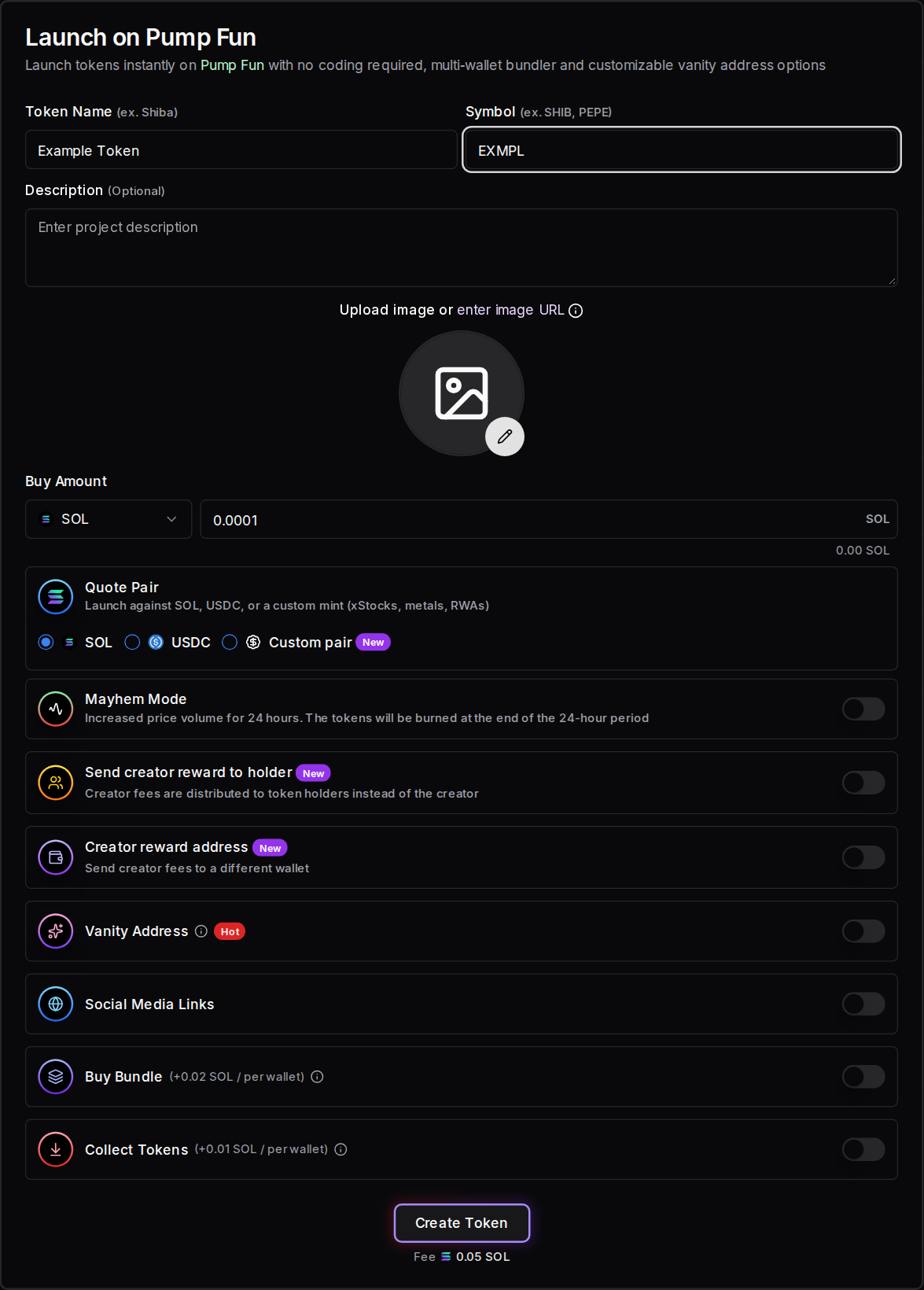
- Launch. Open Create Liquidity Pool, Launch on Pump Fun, Launch on LaunchLab or Launch on Meteora DBC.
How much does each launch cost on Solz.app?
A Pump.fun, LaunchLab or Meteora DBC launch has a 0.05 SOL Solz.app service fee, plus network fees, rent and your own buy. A Raydium CPMM launch costs about 0.32 SOL: 0.05 SOL to create the token, about 0.016 SOL in network fees and rent, and about 0.25 SOL for the pool, plus your liquidity.
| Item | Cost |
|---|---|
| Pump.fun launch | 0.05 SOL, plus about 0.006 SOL on-chain and your own buy |
| LaunchLab launch | 0.05 SOL, plus network fees and your own buy |
| Meteora DBC launch | 0.05 SOL, plus about 0.028 SOL of rent on your own curve, or 0.022 SOL and the launch fee on a launchpad, and your own buy |
| Create a token for a pool | 0.05 SOL, plus about 0.016 SOL in network fees and rent |
| Create a Raydium CPMM pool | 0.06 SOL service fee, Raydium's 0.15 SOL fee and about 0.04 SOL in rent |
| Your liquidity | The amounts you add |
| Buy Bundle on Pump.fun, LaunchLab, Meteora DBC or a Raydium pool | +0.01 SOL per wallet |
| Collect Tokens | +0.01 SOL per wallet |
| Burn liquidity pool (LP) tokens | 0.025 SOL per burn |
| Token Lock | 0.002 SOL per lock |
When you create a pool, Solz.app also checks that you hold a further 0.06 SOL for token accounts.
FAQ
What about Bags?
Bags is a launchpad on Meteora DBC. It sets the curve and the fees, every token's address ends in BAGS, and you claim your creator fees on bags.fm. Choose it on Launch on Meteora DBC, and the Meteora DBC guide covers it.
Can I start on a bonding curve and add my own pool later?
Yes, you can create another pool for a token you hold. More pools for one token split its liquidity, so each trade moves the price more.
Can I launch a token I already created on Pump.fun, LaunchLab or Meteora DBC?
No. These launches create the token as part of the launch. To launch a token you already created, use a liquidity pool.
Which launch is cheapest?
Pump.fun, LaunchLab and Meteora DBC share the lowest Solz.app fee, 0.05 SOL. With the on-chain costs, a Pump.fun launch comes to about 0.056 SOL, and one on your own Meteora DBC curve to about 0.078 SOL. Your own pool costs about 0.32 SOL in fees, and the liquidity is on top. You can withdraw that liquidity later unless you burn it, but its value can change.
Do buyers trust a launch with burned liquidity more?
It removes one risk, because that liquidity can't be pulled. It doesn't say anything about who holds the supply or whether the project is any good, so buyers still need to check those.
Can I change the launch type afterwards?
No. A launch can't be edited, and a token can't move back onto a curve. You can add a pool after launching, as long as you hold the tokens.
Open the tool
Launch on Pump Fun, launch on LaunchLab, launch on Meteora DBC or create a liquidity pool